The Distortion of Indo-European Spirituality

About 2.3 million years ago, the first beings who could be called “human” came to walk this Earth. As they competed amongst one another, as well as other primates, the homo sapien, or Thinking Man, emerged victorious. This marks the birth of our humanity.

At first, we lived as nomads, eating berries, fruits and nuts, and some meat. Over time, humanity came to discover fire and invent the wheel, and this enabled them to make better tools, hunt, cook their food, and create better clothes. They were able to live together in groups.

Humans also had one thing that separated them from all other creatures: the ability to self reflect (Mind). They had all sorts of visions and experiences, and they began to wonder about their own existence. At first, they expressed this in rituals, song and dance. Eventually, they began to record their experiences and spiritual visions in art that they made on cave paintings. According to anthropologists, the emergence of cave paintings marks the end of what we call “pre-history” and the beginning of history.

Modern schools still teach the outdated notion that cave paintings were simply a depiction of things that these ancient people saw, or scenes from daily life. The truth is far from it. Proper studies of these paintings have confirmed that the activities shown are spiritual and occult in nature. We find depictions of shamans, rituals, spirits, animal totems and psychedelic visions. This is loosely known as animism, which gradually evolved into shamanism.

Eventually, a long, long time after this, humanity invented agriculture. This is usually called the beginning of civilisation, and it happened around 10,000 B.C.E (before common era). Humans finally began to settle down, since they no longer had to hunt and gather food. They began to develop religion, and some form of social hierarchy as well as trade.

However, many historians consider the invention of writing to be the true birth of Civilisation. This happened between 5000 and 3000 B.C.E, and here we find the emergence of homogenous societies, walled cities, the division of labour, institutional religion and record keeping.
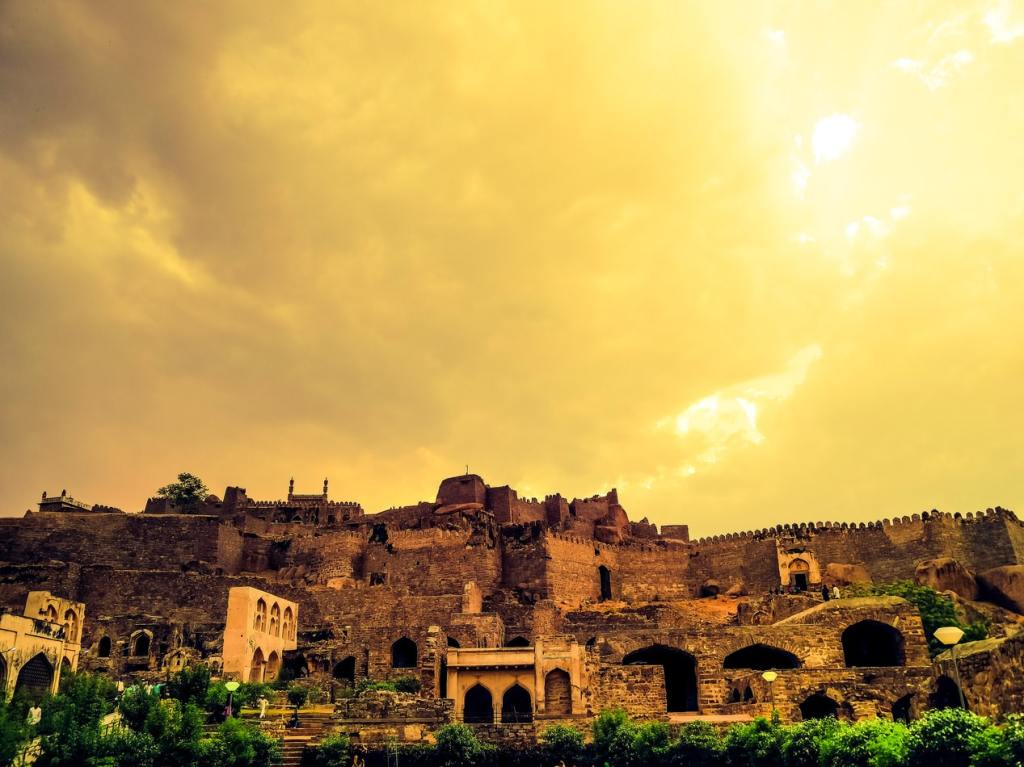
For a long time, historians and anthropologists believed that human Civlilisation began in one single place. For some weird, Eurocentric reason, they decided that this must have been Hellenic Greece. After all, the art in the Renaissance depicted things from classical Greece, and everyone knew that the Greek gods predated Christianity, and after all, philosophy and writing and math and religion and everything else must have been from Hellenic Greece….right?

I mean…what about Alexander the Great (who wasn’t even Greek, but Macedonian)!. And so, for a staggeringly long time, Greece was called the ‘Cradle of Civilisation’. At this time they didn’t know that Greece itself was about 2500 years older than they thought, and Hellenic culture was preceded by Minoan, Cretan and Mycenaean culture. I kid you not, they used to think that Angkor Wat was built by Alexander. Before Carl Jung himself, people of the 19th century thought of ‘ancient’ history as being about 500 – 1000 years old.

But then you see, the British decided that they really, really liked digging. The dig sites in Egypt, the Middle East and Indus Valley pushed our knowledge back thousands of years. And it was discovered that Civilisation was actually much older.

Most of you probably learned in school that Mesopotamia (or Sumeria) is the Cradle of Civilization. However this is also wrong. Recently, anthropologists have begun to agree that Civilisation did not start in a single place at a single time. Honestly, I’m surprised it took this long.

Civilisation started gradually, and in several places independently. It did not start with a singular city/ kingdom like Egypt, Sumeria or Greece, but rather in regions. All of these regions are located along the equator, and thus served as places with a good climate and plenty of water, which is perfect for farming and building cities.

All civilisation can be traced back to essentially six ‘cradles’, and spread outward to other communities and tribes: the Mediterranean, Mesopotamia, China, the Indus Valley, West Africa and the Mesoamerican region.

And yet, there was a seventh, which acted like a kind of ‘binding’ or unifying force, connecting the other six.

A seventh group of people emerged around the same time as all these cultures. Unlike their civilized counterparts, these people emerged in a relatively colder climate. They did not know agriculture, and did not record their language. These people’s understanding of the world was more primitive, and more mystical. They engaged in ritual warfare, blood sacrifice, and consumed a variety of psychedelic substances.

While less sophisticated for their time (living as nomads while everyone else was building cities, as late as 2000 B.C.E), these people had mastered one art: war. And they waged it without restraint, developing entire cults of elite warriors, and expanding like a wild fire across the Eurasian steppe.

Unlike Rome, Egypt and China, their influence is not immediately obvious. We do not talk about their philosophies, marvel at their art, sing songs about them or learn about them in school. And yet, every human being alive today most likely has traces of their blood in his or her veins. Even those who do not, most likely speak a language descended from theirs, or lives in a culture influenced by them. In the collective consciousness of humanity, there is a shamanic current of magick that can be tapped into by every living man and woman, as powerful as the currents of Pagan, Abrahamic, Dharmic and Totemic magick. In fact, you’re reading this blog post in a language that was probably similar to theirs.

So settle in, because today i’m going to tell you a story. A story of war, drugs and deviance. A story of magick, of blood, and the strange things that happen at the very edge of civilisation. This is the story of the Indo-Europeans, and their magick, and how it is hidden away from most modern magicians.

Why Indo-Europeans

Despite many political ideologies claiming otherwise, the Indo-Europeans are not actually very ancient. They are also not the only shamanic culture (obviously), and similar traditions can be found in basically ALL ancient cultures.

Understand that Shamanism died out a pretty long time ago, and got replaced by the more organised cults we recognize. Practically all cultures were originally shamanic and animistic. While such cultures may have been technologically backward, they represent the most spiritually connected humanity has ever been. Today, we basically have no way to study such periods in our cultures. Even if we look back at the oldest records from, say, Egypt, we find organised religious cults, with priesthoods and temples. Yes, we can find some remnants of shamanic cultures in Siberia, Africa and America, but these are already on the verge of disappearing.
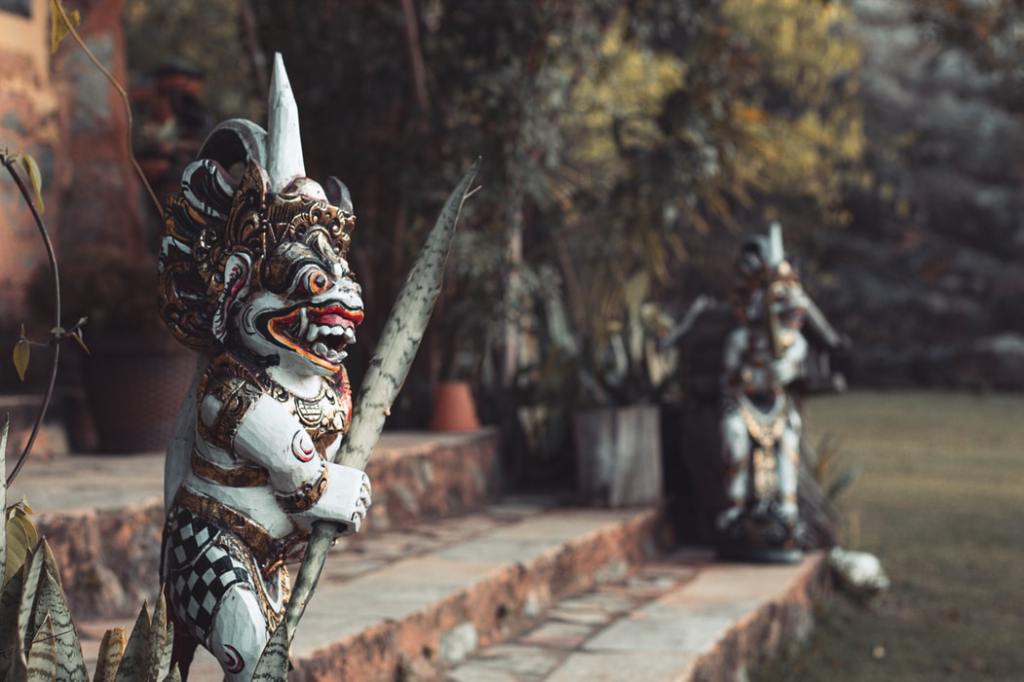
However, the Indo-Europeans were a peculiar set of cultures, and they remained shamanic until very late. The latest Indo-European shamanic tradition to die out was Norse paganism (heathenism), which was around until just 1000 years ago. It was soon replaced by the Christianised, Nordic culture we recognize today.

Now yes, you could say that parts of Africa and the Americas remained shamanic until much more recently, but due to colonisation these traditions disappeared really quickly, as Christianity and Islam rapidly spread through the regions. As strange as this sounds, the British were the only colonial power that had some interest in studying and recording the shamanic cultures they encountered. This is why there are still some tribal cultures in India left. But India being India, it’s probably going to be another century until someone gets around to properly studying the non Indo European, Adivasi traditions of India and detailing them.

The rest, such as Spain, Germany and France, either did not understand the importance of this or did not care. They quickly converted local populations, and spread their language. Now there are the Australian aborigines who actually seem to have a fully intact shamanic culture, preserved roally with astonishing accuracy and going back 60,000 years, possibly even before the last ice age. But for whatever reason people act like the Aborigines don’t exist. That is to say, I haven’t found enough relevant information to put it into the context of shamanic magick. Perhaps someone else will do a better job.

I hope what I’m saying makes sense. If we look at a majority of cultures today, it is impossible to say what is a remnant of shamanism.

With the Norse, we have this unique case where a culture was encountered by the ‘civilised’ world, but remained intact long enough for detailed records to be taken. By studying what was recorded of Norse culture, we have a great way of doing a comparative study with other cultures, and slowly piecing together Indo-European traditions and culture, such as the Slavic, Avestan, Vedic, Ainu, Tocharian, Baltic, Germanic and Italo-Celtic. Of course, as we will see in this post, most of what is recorded about Norse paganism is ALSO completely wrong, hence the title. But, it’s better than nothing. Another such culture is the Germanic one, which was recorded to some degree by the Romans. However, this too is biased and distorted.

So, to reiterate, I’m not saying the Indo-Europeans are the only ones who had these ideas, or that they are superior to others. All i’m saying is: ancient shamanism represents magick and spirituality at it’s most potent form, and Indo-European shamanism is one of the best ways to study it, because the Indo-Europeans were 1. very profilic and widespread, 2. very recent, and 3. the only ones which are well documented (norse and germanic). Due to this, we have reconstructed and studied their beliefs better than basically ANY shamanic culture.

We have been studying Indo-Europeans for over 100 years now, while we have only begun to study the shamanic past of other cultures. Also, due to the current existence of Hinduism, and by extension the Vedas, Indo-European shamanism is the only shamanic culture which has authentic written records. Parts of the Vedas are essentially the only written records of an ancient shamanic religion in existence. There was the Avesta, but the book was lost at one point and what we have today is a reconstruction made from oral accounts by the later Persians. As we have discussed before, the Norse Sagas were recorded by Christians, while Germanic culture was recorded by Romans.

Dark Origins

I’m not going to delve into the exact details of the Indo-European migration pattern. You can watch this video to watch a time lapse of how they spread, and the cultures that are their closest successors. Also, this post is about Indo-European culture, not ethnicity, and these concepts are not limited just to those who have more Indo-European ancestry. If you like a spiritual practice or idea, you’re free to use it.

The Indo Europeans were an ethno-linguistic group of people that first emerged around the 4th millennium B.C.E, though they are most likely about twice as old as that. Technically, we should call them ‘proto-Indo-European’. The word ‘Indo-European’ is simply a word that refers to the cultures of North India, Persia, Europe, Central Asia and Russia (and some others). Technically, all modern people of these regions are Indo-European. The people we are talking about were the common ancestor to such cultures, hence the word ‘proto’.

However, to save me the trouble of having to write ‘proto-Indo-European’ again and again, I’m just going to call them Indo-European.

Contrary to popular belief, we don’t actually know exactly where they came from. There are many hypothesis, the most common being that they originated from Anatolia, Armenia or (most popularly) around the Caspian.

They were tribal nomads, with a heavy emphasis on war. To understand the Indo-European world view, we must understand their cosmology.

Many of you may be aware of the Indian caste system. This system began in the Vedic period. Although over the millenia it has become vast and complex, in the VEdic age it included just 4 ‘castes’. These were the Brahmins (preists), Kshatriyas (warriors), Vaishyas (Merchants) and Shudhras (labourers). However, originally there were only the first 3 (mentioned in the Rigveda), and ‘shudhra’ is a much later addition.

Thus, the idea of a triple hierarchy is fundamental to the Indo-European mindset. They used this to organise their societies and also to understand and approach their Gods and spirits. Indo-European society was divided into 3 classes. At the top were the priests and kings, in the middle were warriors, and at the bottom were merchants and craftsmen. We can imagine that slaves, prisoners and other such people would fall outside the class system. In India, this idea would reemerge ‘untouchables’ in the middle ages. In other words, the Indo Europeans very much believed in an ingroup vs outgroup mentality. If you ever wondered why the Vikings raided foreign cultures with such brutality and lack of mercy, this should explain it.
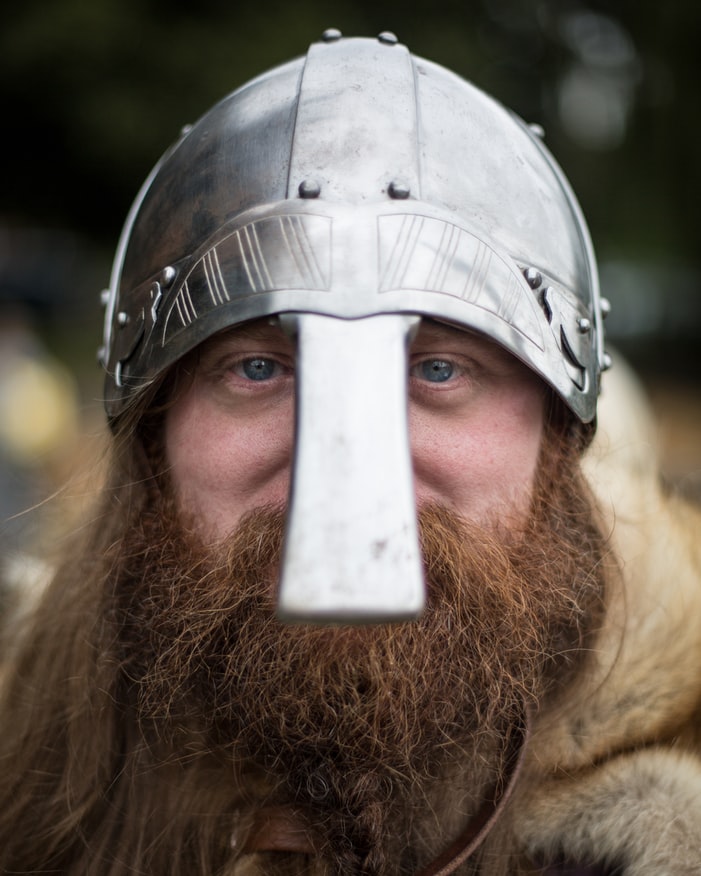
This system determined social status. Thus, Indo-European cosmology also divided the world into 3 groups: the heavens, the earth and the underworld. We can actually see some remnants of this in the Greek gods Zeus, Poseidon and Hades ruling the sky, the sea and underworld respectively. Many Indo-European cultures have 3 gods who play a primary role in creating the Universe.

Another common motif is sacrifice. These societies were highly sacrificial, and animal sacrifice in the performance of various rituals was common. It seems even human sacrifice took place, but we’ll get to that later. In the Vedas and Norse poetic eddas, such rituals of sacrifice are recorded. It also appears that at times, in some places, cannibalism may also have occurred.

Therefore, most Indo-European mythology also talks about the 3 primary Gods ‘sacrificing’ a being to create the world. You are all probably familiar with the Greek story of Zeus, Poseidon and Hades killing their father Kronos and casing him into Tartarus. However, the original story probably involved his pieces being used to make the world. In Vedic mythology, the brothers Indra, Agni and Varuna sacrifice the primordial giant Purusha (meaning ‘man’) to create the world. In Norse mythology, this is done by Odin and his brothers to the giant Ymir.

The Indo Europeans believed heavily in spirits, and spirits most likely were more important than Gods. Look at Russia and Central Asia today, where people still largely believe in all sorts of spirits and urban legends derived from them, despite being Christian.

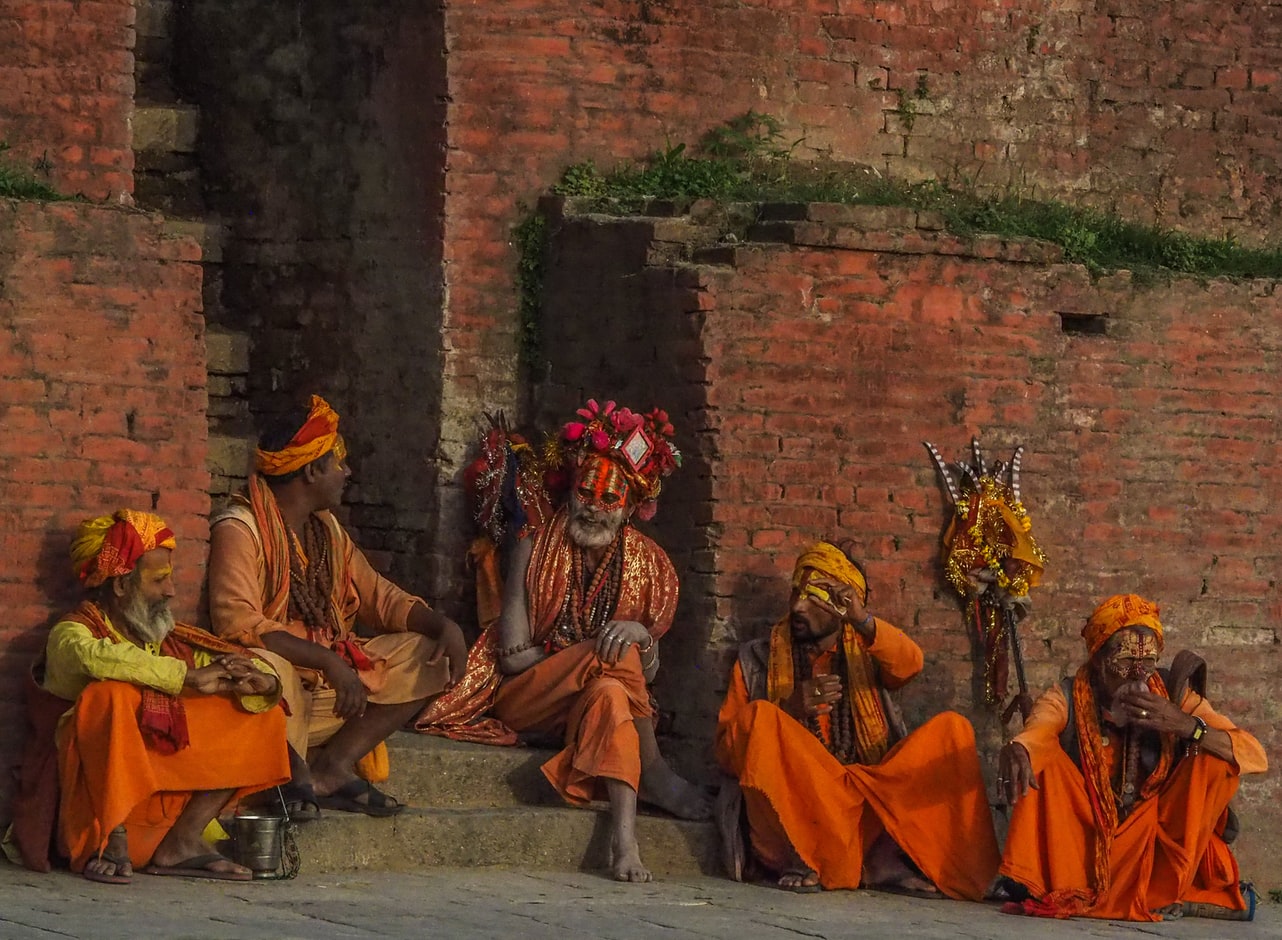
Finally, the Shaman was a vital figure in Indo-European culture. To us modern occultists, this figure is the one that most closely resembles us. The Shaman was not a priest. Instead, they lay outside the social heirarchy, a figure both feared and revered.

The Indo-Europeans expanded rapidly because of the importance they placed on war. Many of them had elite groups of warriors, whose sole job was to live in packs and conduct raids on foreign tribes. This is most likely the precursor to the Norse idea of the Berserker, as well as werewolves (man-wolf).

They also focused heavily on developing their techniques of warfare. One of the reasons why the Indo-Aryans came to dominate Northern India, was because they had swords and war chariots. The natives of the Indus Valley could not counter this with their spear infantries. Infact, the Swastika which was a symbol of war and violence, became a symbol of peace and prosperity only in recent times. To the Indo-Europeans, ‘prosperity’ meant raiding and war. This idea continued well into the modern era, with the Vikings raids being the last example of such aggression. In India, cows are considered sacred because they are used in agriculture. However, the horse was the precursor to the cow. In the Vedas, horses are depicted as the primary sacred animal. Cows were sacred too, but as a sacrificial animal. All Indo European cultures venerated the sacred cow, and even the solar bull. However, as the Indo-Europeans became agrarian, the cow became a symbol of agriculture. Killing cows probably became taboo to stop farmers from killing their own cows in times of hardship, or perhaps so that people would not steal agricultural cows and kill them for meat.

However, the Indo-Europeans lacked stability. The average life expectancy was probably around 30 years. While most warlke cultures assimilate others into their ranks, the opposite happened to the Indo-Europeans. They themselves became assimilated into the larger societies they encountered. The relationship was not just of war, but also trade, cultural interaction and the exchange of ideas and technology. The Indo-Europeans brought weapons, psychadelics and mythology, while the cultures they encountered had agriculture, math and systems of economy and religion.

Contrary to popular belief, there are no ‘pure’ Indo-Europeans. The people of Russia, Europe and North India are a complex admixture of different groups. Therefore, we cannot call them ‘white’, ‘aryan’ or ‘asiatic’. They simply spread across the world and assimilated into all the cultures they encountered. Even in Northern Europe, which appears to be ‘pure’, there were people living there prior to the Indo-European migration. These are often called Eastern and Western hunter gatherers. The Western hunter gatherers came from Africa, while the Eastern ones were native to Europe. The Indo Europeans merged into these two cultures, producing the various cultures of Europe we see today.
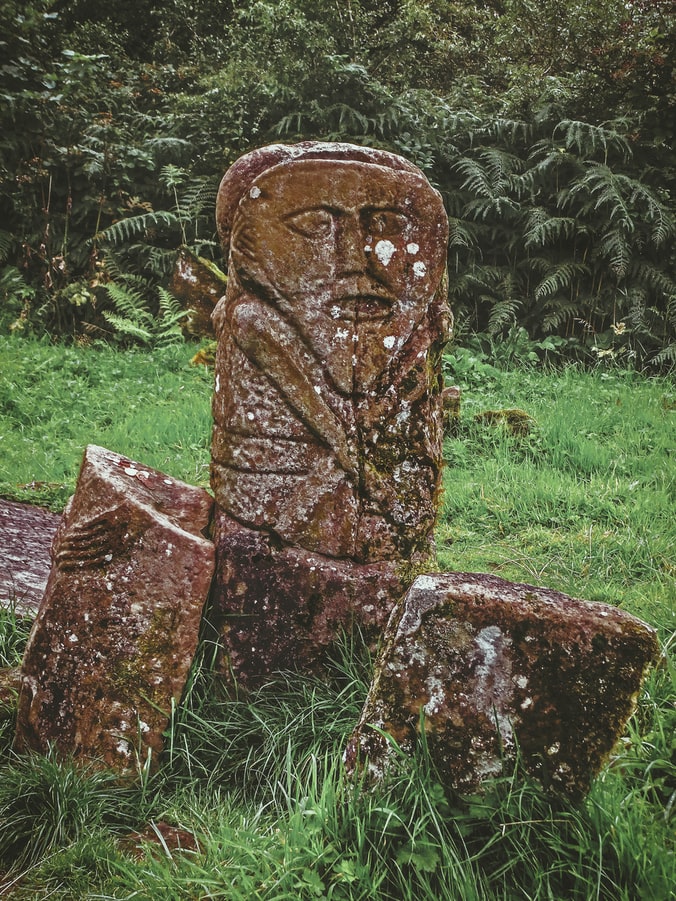
Culture is not race. Ethnicity, language and culture are linked, yes, but they do not define each other.

This is why I called them a ‘unifying’ or ‘binding’ force. The Indo-Europeans even expanded into East Asia, and the Tocharians of China, as well as the native Ainu people of Japan are examples of Indo-European cultures.

One distinctive trait of Indo-European culture is how colourful it is. While seemingly not as elegant as the cultures it merged into, the use of bright colours and psychedelic patterns is noteworthy. This is something Hollywood often forgets in depictions of Vikings, showing them wearing dark, grungy clothes and using a lot of black, when in reality they are always described in accounts as wearing brightly colored clothing.

This may be the reason why North Indian culture has so much emphasis on bright colours and psychedelic patterns, while South Indian clothing and culture is usually more minimalist and serene.

The Figure of the Shaman

The Shaman was an occultist. They would impart both wisdom, as well engage in obscenities.

A shaman did not choose to become a shaman, but instead he was chosen. There is evidence that this happened in all Indo-European cultures. Once chosen by the spirits, the shaman had little choice in whether he or she would accept. In fact, it seems in some cultures the choices were: accept your role and die.

However, it’s not all that bleak. When we look at siberian shamans, it seems that the people who become shamans are outliers anyways. According to Dr. Jordan Peterson regarding Siberian shamans, the people who become shamans are already intuitive and sensitive, and already have spiritual experiences. For the Siberians the people who are to be shamans would have unusual or eccentric traits, having an affinity for ritual and expression, and preferring to spend time alone in places like graveyards or forests. They develop a kind of “mania” where they go off into the forest and live as animals. It is the job of the shamanic initiate to overcome these trials, get past their mania, and integrate their experiences into their own culture, so that they may return and become guides to their tribes. When people encounter something they don’t understand, they turn to the shaman for answers.

As Terrence McKenna once noted, the shaman was like a figure whose designated job was to ‘be weird’. He would be allowed to do what he wanted, and live at the edge of the village, and come when called. He would tell people how they were meant to interact with the unknown, and how to read omens, and what decisions to make in times of great upheaval. A Shaman was someone who ‘generated culture’. I agree with this notion.
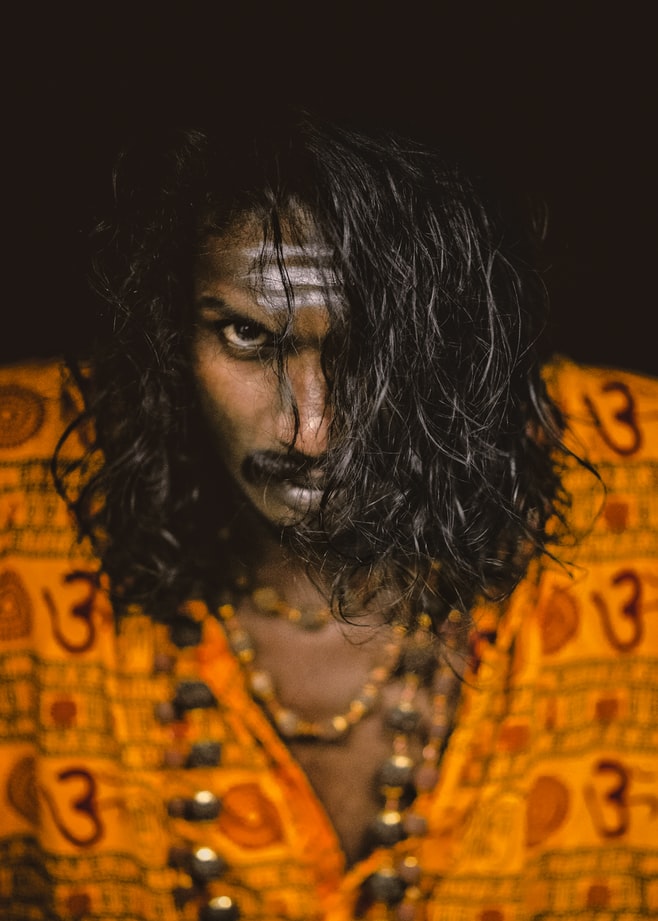
In Germany, Shamans would sometimes take autistic or deviant children under their wing, and use their specific inclination for visionary experiences, training them to be shamans. In other words, these ancient societies wanted to ensure that each and every person had a role to play in society. Even people who could not live as normal, had to be given a place in the world. This is the exact opposite of what we do today. While we can easily point to Christianity and blame them, it was in fact the Hellenic Greeks who were the first to ban certain types of magick and spiritual practices that offended their puritan and aesthetic sensibilities. Rome took this to the extreme at times, and as well all know, the Church was born out of the dying legacy of Rome, and retained this tendency for puritanism.

According to Peterson, the difference between a true shaman and someone who’s simply gone mad, is the ability to integrate their experiences. By the way, this is why occult traditions like kabbalah, rosicrucianism, neo-paganism, satanism, vedanta etc. have a religious basis. Religion and culture gives a framework within which an occultist can place his experiences, and convey them to others. Anybody who has practiced magick for long enough, knows that eventually you run out of words to describe your experiences. The ancient sufi mystics struggled with this, so they chose to express themselves in song and dance. Without religion, we would have no way to tell others what was going on. By falling back on mythologies, folk legends and scripture, we can express ourselves, and also convey the gravity and importance of magick. “I invoked the Archangel Mikhael” carries a lot more weight that “I had a strange experience where something unspeakable communed with me”.

One great example is St. Jerome, who had a terrifying vision of a flaming face that threatened to completely shatter his sanity. It was only because he could fall back on religion, and express his vision as the Holy Trinity, that he was spared the fate of losing his mind. Anyway, back to the topic at hand.

For the Indo-Europeans, the shaman was regarded with both fear and reverence. This fact may offend people, but these shamans were frequently androgynous. Not necessarily in appearance, but in behavior. The practice of magick dissolves those strong, dualistic boundaries between gender. This is why I question the caliber of those gnostics and kabbalists who so confidently claim that homosexuality is evil or that certain magick may be practiced only by one gender. Even the author of the Book of Abramelin is forced to admit that magick could be practiced by both men and women, even though he was clearly influenced by the beliefs of his time.

So yes, the indo-european shamans did not fall into rigid categories. Sometimes, they would cross dress in order to perform certain rituals. In Norse mythology, Odin is a shamanic figure (he’s NOT the ‘allfather’. More on that later). He is often shown to have bisexual tendencies and traits. However, shamans were also in control of their desires. Unlike what modern culture espouses, they were not sexually promiscuous nor did they chase after pleasure. They weren’t ascetic, but they practiced a high level of self control.

Often, the shamans would be aided by spirits, and there were many types of these. In modern times we make strong distinctions between “angels” or “demons” or “gods” or “spirits”. But to the shamans, these did not exist. Spirits were spirits, and categorized only by their nature and the role they played. Unlike the assertions of some thelemites and kabbalists, the spirits were understood to have free will. They were conscious beings, just like us. Some were ancestors, some were former shamans, some were divine spirits, and the others were animals totems. The shaman would commune with them to gain knowledge, perform tasks, and tell the future.

The end goal for the shaman, as it is for us modern magicians, was to solidify the body of light and integrate the shadow. Through this, he would gain immortal life. Some shamans were also vampyric. This is most likely the origin of the legend of vampires, and perhaps even the native american wendigo.

Cult Activity

Anthropologists often use the word “cult” to refer to the various facets of Indo-European beliefs. But this does not mean we are talking about “cults” in the modern sense. For example, when we say ‘Indo-European Snake cult’, that doesn’t mean there was some single religious group that spread across all the tribes and worshiped a snake god. It refers to the collective tendency among Indo-Europeans of revering serpents.

There are many Indo-European cults that form many aspects of modern magick.

The Hearth Cult is perhaps the most evident in modern day religions. Originally, the tribes were fire worshipers. In the Indo-European tribes who spread into Europe, this became the hearth cult. This is why even in modern day Europe, you have the fire place as a central piece of the house. We tell children that Santa Claus climbs down the chimney of the fire place and comes bearing presents. Originally, the most important Gods of the house dwelt in the fire place, as did the ancestors, and they brought good fortune to people. I wonder if these two are linked. In the warmer climates or Persia and India, the fire cult became the sacrifical fire. The Vedic Hindus conducted fire rituals, the Zoroastrians use it as the primary object of devition to this day.

The Death Cult refers to the ancestor worship that was common among Indo-Europeans. Ancestors were very, very important to these people. Ancestors does not just mean your biological predecessors, but even ‘spiritual’ ancestors. For example, a Shaman could regard all previous Shamans as his ancestors. When a woman got married, she would leave her previous lineage behind and the ancestors of her new family “adopted” her. This may be why even today, women often change their last name. In India, there is this idea of “gotra”. Modern Hindus have forgotten what it means, but it basically means “ancestral lineage”.

This may sound patriarchical, but the Indo-Europeans used this to ensure that ancestral property could be passed on. Yes, there were matriarchal Indo-European tribes as well, and in these the opposite would happen. To the Indo-Europeans, the left side of the body was to do with death, while the right side was to do with life. You will notice that we still adhere to the idea of the left and right hand paths of magick.

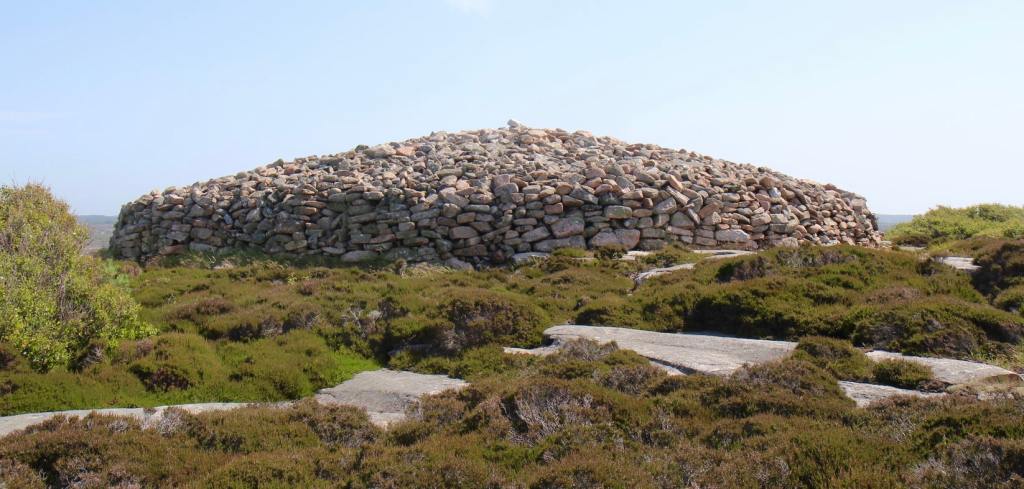
For the Northern tribes of Indo-Europeans, the dead would be buried in burial mounds. These ancestors could then be communed with, and all magick of necromancy (the art of divination by speaking with the dead) would be done at such mounds. The Norse believed that sleeping on mounds at night would grant visions of the dead, and that such mounds should not be desecrated. Notice that in Ireland, there are many folk tales of spirits and ghosts appearing near ancient burial mounds.

The wolf cults and bear cults are pretty important. To the ancient Indo-Europeans, war and the concept of warrior hood was important. Practically all societies to ever exist had rites of initiation for young boys, enabling them to become men. Many tribes also held such rites for girls to become women. In the Rigveda, it is said that in order to become a man, young boys must sacrifice a wild dog in a ritual ceremony. They must then wear this skin and live in the forest as wild dogs, away from the village of tribe. Eventually, they would return to the tribe as men. I find it interesting that even now, most people will attend four years of college between school and proper adulthood.

It was common with many other Indo-European tribes as well. In Norse tribal society, groups of young men who had been banished from the tribe would live in the wild and form their own packs. They were called vargr (wolf). These packs would later become elite groups of savage warriors, donning the skin of bears and wolves and going into battle during the Viking age. These were the “berserkir” (those who wear the bear skin).

Indo-European wolf cults are most likely where the story of werewolves come from. Donning the skin of wolves, the warriors would try to awaken their own primal, animal nature. Native American shamans are also known to use the skin of animals to ‘transform’ into animals. I myself have had such atavistic experiences during my invocations of certain dark spirits associated with death and violence. We know that many Indo-Europeans called themselves “Aryan”. I have seen it suggested that maybe this was the root word for Ares, the Greek God of War.

Some other aspects of Indo-European spiritual life were the emphasis on purity. Divination and oral traditions were also a huge part. Even in many late pagan successors, such as ancient Greece, you would have Oracles, all of whom were virgin girls. In Germany and Northern Europe, the male heads of the family would take part in divination rites using runes, while female elders would preserve and pass on sacred songs and hymns.

Another common story is the idea of two warring factions of Gods, who also co-operate and intermarry. The Devas and Asuras, the Aesir and the Vanir, the Olympians and Titans etc.

I personally believe our modern concept of Angels and Demons came from this. It is a relatively unknown fact that the Avesta is Indo-European. The Avestans also believed in the Devas and Asuras (although to them, the terms were reversed). Eventually Zoroaster reformed the religion. In this way, Zoroastrianism is the first truly dualistic, monotheistic religion. However, it retained some of it’s Indo-European traits. You could even call it the first Abrahamic religion. In fact, many Jewish myths and concepts are taken directly from it, as the Jews were in Babylon for a while, and the Old Testament was written after they were released and sent back to Palestine/Israel/Judea. Many people are not familiar with the fact that Judaism was, originally, highly monistic. This is why in some ancient Jewish sources, Satan/Sataniel is depicted as an angel. It was only after their exile, that Judiasm starts to take in the highly dualistic nature of Zoroastrianism. This is when the separation of God and his angels and the Devil and his demons comes from.

So, in a way, the Angels and Demons are akin to the Indo-European factions of deities. We will see why this matters later. Just remember that the Indo-Europeans were monists, not dualists. The Dualism comes about specifically in Zoroastrian mythology. However, most turned dualist after becoming exposed to Buddhism, Christianity, and Islam. These were/are, after all, the religions of the Age of Pisces. And Pisces is dualistic.

And almost all Indo-Europeans believed in the cyclical nature of Time. To them, Time was not linear, but moved in cycles. There were no “end times”, but rather the transition from one Age to the next.

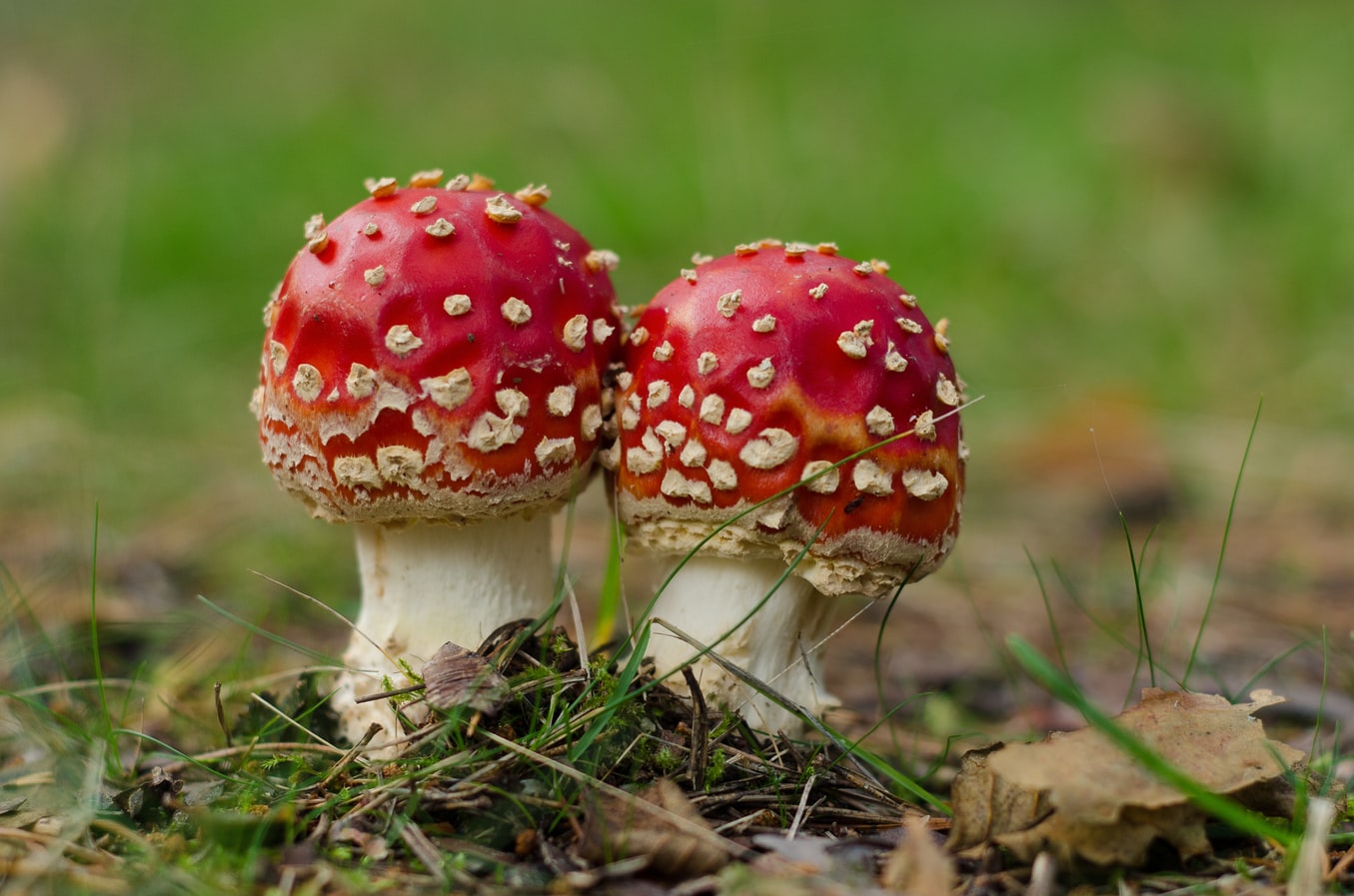
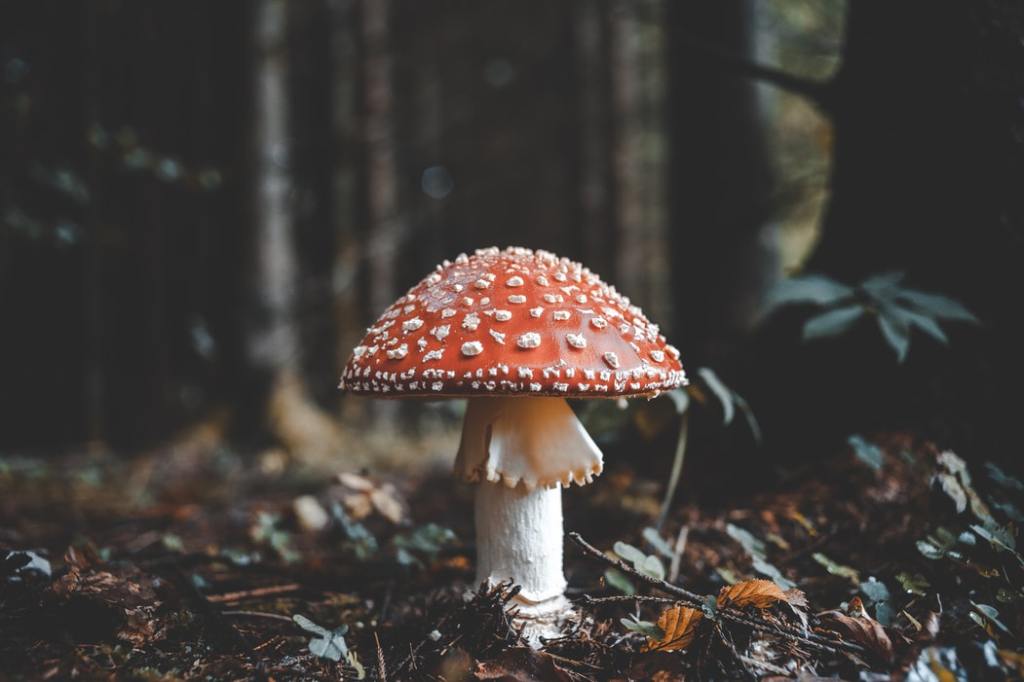
Psychadelics also played a major role in their belief systems. For the Vedic people, there was a substance called soma, which was consumed before rituals. We know that the Norse most likely consumed psilocybin mushrooms, perhaps even before battle and during rituals. In Siberia, the Shamans use amanita muscaria mushrooms, usually using their own body or the body of the reindeer as a filter, and drinking the urine which contains the psychadelic compound without the toxins. The Mycaneans and Minoans also used psychadelics, as did most likely the Germanic and Celtic people.
There are many more cults, but you get the general idea. Now That I’ve given a rough idea of who and what the Indo-Europeans were, I want to talk about how our perception of the ancient pagan, vedic and shamanic past has been utterly distorted in modern times.

The Cult of the Sky Father

“Cult of the Sky Father” sounds like an insult that an edgy pagan or atheist would hurl at the abrahamists.

It may interest you to know that I’m actually referring to a late facet of Indo-European culture.

When most people think “pagan”, what comes to mind? Why, Zeus, Odin and Thor of course. The “enlightened culture” that existed before Christianity destroyed it and ‘stole’ its gods. Why, anybody can see the parallels between the Abrahamic and Pagan religions, right?

Wrong.

But not entirely.

I suggest that you read my invocation of Dionysus. In that post, I went over the general history of Greek religion, which I will use as an example.

Greece does have significant Indo-European impact. When people think of ancient Greece, they always think of Hellenic Greece. Many people do not realise that Hellenic world represents one of the final stages of Greek civilisation, when the religious and spiritual thought had declined a lot, and people were increasingly materialistic. Hellenic Greece was preceded by Mycenaean and Minoan cultures, and is actually nearly 2500 years older.. For most of this time, Zeus was not the primary deity. In fact, even in Hellenic Greece different Gods were worshiped in different City States.

In Mycenaean culture, the Elusinian Mysteries were very prominent. Persephone, Hades, Poseidon and Dionysus were primary deities, and the spirituality focused a lot of Cthonic (underworld) aspects. Zeus (the sky father) only came into focus in the later, philosophical period. In fact, I’d say the prominence of Zeus only became truly apparent with Rome, and it’s over emphasis on the worship of Jupiter and Mars.

Now let’s talk about the Norse. Today people think of the Norse Pantheon as resembling the Greek pantheon, with Odin residing as the “allfather” over his council of Gods.

In truth, the primary deities in Scandinavia were originally Tyr and Thor. The Cult of Wotan was brought into Scandinavia by Germanic tribes, after which Wotan was known as Odin and his worship became immensely popular. However, he was not the God of Light or the Sun. He was actually a God of Death and related to divination. Almost all stories of Odin present him as an extreme and ambitious figure, who discovered many abilities of Magick. Yes, Tyr was a war god, while Thor was a heroic figure. But these were not the first nor the most popular Gods worshipped by the Norse. The figure of Loki is most likely far older than Thor, as a god of the hearth. The idea of Tyr and Thor as sky fathers itself may have been a later projection, to make them more like Zeus.

In fact, if we’re really talking about “sky father”, then historians generally agree that most Indo-European ‘sky fathers’ came from one specific deity, which they call Dyeus (meaning father of heaven). This is where the more modern Latin word Deus (meaning ‘God’) comes from. Zeus, Tyr, Jove, Indra, Perkunas and all other Patriarchs in Indo-European myths are derived form this one concept. And yet, it is questionable how much we actually understand Dyeus, and how much historians are projecting the Christian Deus onto Dyeus.
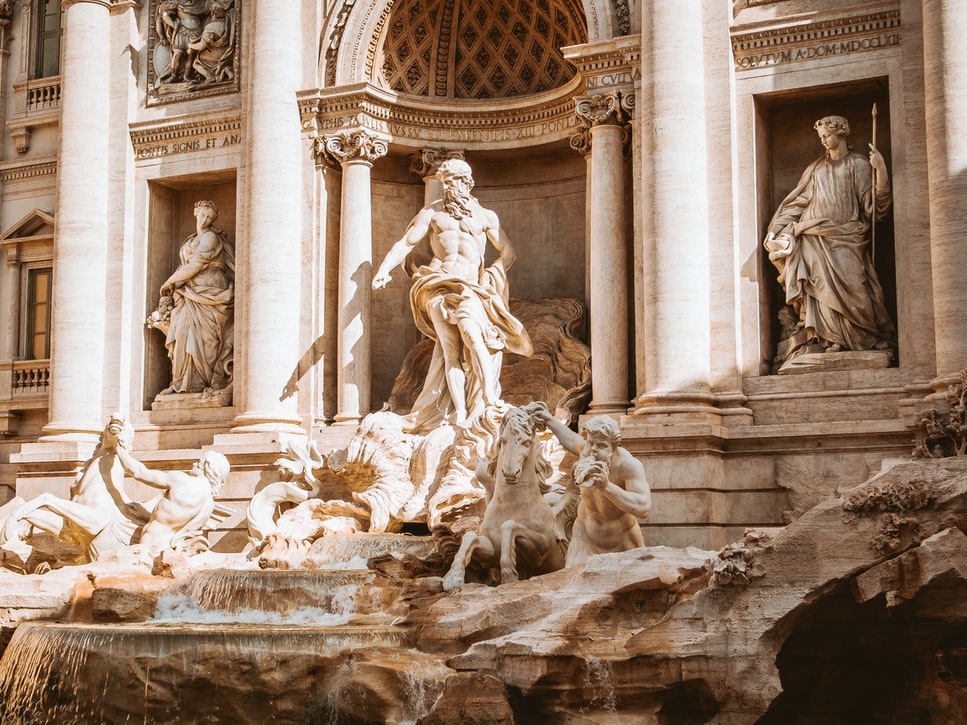
Most likely the original Germanic Wodan was a deity to whom sacrifices were made, and who aided in the work of divination. He has also been noted to have cannibalistic and bestial tendencies. But then again, all of this is coming from Romans, who thought the Germans were barbarians, so who knows how true it even is (we will discuss this more in the next section).

Are you beginning to see my point?

Christianity is not the first religion to introduce the “sky father” nor Judaism. And, the previous sky fathers like Zeus and Odin are not the ‘original’ pagan deities either.

For some reason, people look at history in a very dualistic manner. They see history as being clearly separated between “ancient” times and “modern” times. They also think that both these periods were generally the same and consistent across space and time.

For example, many modern pagans people think that first there was the pagan era, where there was some sort of universal pagan faith follow by all people in Europe and the Middle East. Then came the Abrahamic era, and suddenly the pagan religions were subverted and replaced by Judaism, Christianity and Islam, which were exactly the same as they are now.

Many modern Hindus think the same. They think Hinduism was some singular, homogeneous force that existed from pre-historic times until the Classical Era, when it got replaced by Buddhism. Then it got subverted by Islam and Christianity in the Middle Ages, and returned to it’s original form in the 19th century.

In truth, history is complex. It is a large tapestry of different beliefs, groups and ideologies. All spiritual traditions evolve over time, and sometimes absorb or get subverted by other traditions. It also differs vastly from region to region. Christianity and Islam are a special case, because no religion in history ever went to the same lengths to subvert and wipe out other religions. These were the first religions that introduced the idea of conversion, heresy and apostasy on a large scale. Perhaps it is correct to say that Christianity was a specific Judeo-Hellenic cult that went way too far, and Islam emerged as a response to it.

Yes, we can point a finger at the Abrahamic religions. But the truth is that the Cult of Wotan was just as ‘foreign’ to Northern Europe as Christianity. The truth is that the worship of Zeus may have been just as forced upon the Orphic cults as Christianity. In fact, Zues was probably less popular than Christ. We say Christianity and Islam sterilised spirituality. But did the Hellenic philosophical religions not sterilize it first in Greece?
To clarify, I’m not defending modern Christianity and Islam. I do think they’re sterilised, but so are many new age traditions and neo-pagan religions. Do not be so convinced that Odin and Zeus and Osiris are ‘true’ Gods and the Abrahamic ones are ‘untrue’. Even in Egypt, the Cult of Horus subverted and replaced the Cults of Ra and Seth at one point. I’m sure this is obvious, but a religion does not stay exactly the same for over 9000 years. Heck, things don’t even stay the same for a hundred years. Think about how different you and your beliefs are from your grandparents.

Additionally, let us not forget that Christianity and Islam have also evolved over the ages. Followers of these two religions will not admit to this, but we know it’s true. Let’s not forget that these religions are simply the most modern evolution of older religions.

Let us take a look at the Hindus. The Vedic people practiced animal sacrifice, and all manner of other rituals. They were warriors, and put a great emphasis on visions, intoxication and embracing their “wild side”. They practiced magic, performed rituals of ecstasy, and subjected the young men and women to rites of initiation. They greatly valued qualities of leadership and independence, and aggression.
Indra was a God of War, not of the Sun or Rain. It was much later than this tribal war god became a God of the Sky and Rain.

Hinduism today has a distinctly Victorian and Socialist characteristic, and you can barely call it Vedic in any real sense. If anything, I’d say it’s entirely from the 19th and 20th centuries. The Introduction of the figures of Krishna and Brahma happened quite late, compared to the Vedic deities.

“Alright Raven, we get it. Religion evolves and differs over time and place. Odin, Brahma and Zeus are not necessarily the ‘original Gods’ and Christianity and Islam are not entirely to blame. But shouldn’t everyone just follow what makes sense to them?”

Oh, absolutely. I’m not saying that you shouldn’t work with the deities that make sense to you. My own beliefs and practices are a vast mixture of various traditions.

However, there’s another thing I need to mention. This one is more important than the last, and the one that will really drive home the point.

Agenda Narratives

People tend to forget that when we look at mythology, we are often looking at the writings of very specific people. For example, most of our understanding of Greek mythology comes from Hesiod (poet from 6th century BCE), who compiled most of it. In other words, this is his personal opinion, and understanding of these myths. Our knowledge of Norse mythology comes from the Poetic Edda and the Prose Edda. For Vedic myths, we are largely relying on the translations made by English historians as late as the 19th-20th centuries. For the Avesta, the originals were lost in a fire, and then the book was reconstructed centuries later based on memory and oral tradition. Our understanding of Slavic mythology comes almost completely from one German monk, called the Chronica Slavorum.

This affects some traditions more than others. For example, the Egyptians left over 9000 years of literature and history, and detailed records of their spiritual, religious and magical practices painted on stone walls. Stone tends to last for a long time. And we can translate it with full accuracy. The same could be said for Abrahamic myths. While a bit fragmented, we still do have very old documents. Hermetic, Mayan, Chinese and Aztec traditions are also well recorded and preserved.

But some are not. The Indo-European cultures were largely oral. Even when people like Hesiod wrote down myths, it was often centuries after they had been conceived, and any truly mystical or occult connotations had been lost. As far as Hesiod was concerned, these myths to him were the same as biblical myths are today: something to believe in, and a list of religious duties to perform. Secondly, most early records are lost.

For example, we know that the Vedas must be thousands of years old. And yet, these were written on palm leaves, and have long since disintegrated. The earliest records we have are on tree barks from 1100 BCE. Even if the Indo-Europeans made written records, most of these were probably on non-durable material like leaves. We are now forced to reconstruct their beliefs using burial mounds, such as those left by the Norse, the Britons and the Celts. For Aryans, we don’t even have those, since neither Zoroastrians nor Hindus preserve the bodies.

Coming back to agendas, let us consider Greek mythology once again. Have you ever noticed how many of the Greek gods seem to be..well, assholes?

No offence, but let’s get real. These are essentially Gods that were worshiped in a powerful and intellectual civilisation. Why then, do Zeus and Poseidon appear to be an arrogant perverts, Dionysus a drunkard, or Apollo a playboy? Why are the Gods so often petty, childish or foolhardy? Why would a culture like the Greeks worship them, even before the Hellenic era. Well the answer is simple: people with agendas.

Ovid was a Roman poet who is well known for having written about Greek myths You see, Ovid was exiled by Rome for criticizing Emperor Augustus. So, naturally, he had a bit of an anti-authorotarian bias. In his collections of mythology, he would often frame the stories to play up the negative aspects of the Gods, and portray mortals as hapless victims.

Let’s take a modern example. Think about how modern people interpret the Bible to make Jehovah out to be violent, judgmental and arrogant. This is because Christianity and Judaism are fading out, while Paganism and Satanism are beginning to boom. Such similar things happened many times in history. Many pagan myths we have today were recorded in a time when people already lost interest in them, and were beginning to poke holes in them.

Let us take Hindu myths. In many, many Hindu myths, the Vedic gods are made out to be arrogant and petty. Indra, who was the primary God of the Indo-Aryans, is often portrayed as being embarrassed or humbled by other Gods like Krishna or Shiva. This has led to many modern Hindus believing that the Vedic gods were somehow lesser to the non Vedic ones. In truth, many of these legends came around when Vedic religion was waning, and being replaced by Puranic and Bhakti traditions. They represent a biased opinion of certain individuals, not even necessarily a whole culture, and definitely not a mystical or spiritual truth.

Much of Germanic, Iberian, Britannic and Celtic mythology is recorded by Romans, who believed them to be barbarians. While personally I think the Romans would have been much more true to what they say and objective in their approach, remember that they were not exactly held up to any rigorous standard of documentation. At the end of the day, it really is just the opinions of Roman historians.

So what is my point? Simply, that pretty much all Indo-European mythology we have is extremely recent, compared to how old these ideas really are. These are, more often than not, written by specific individuals. But that’s not even scratching the surface. Because now we have to deal with Christianity (oh boy).

If you read my previous post about the Fae, you’ll see how Irish and Celtic mythology was distorted to fit into Christianity. So I’ll skip over that, since Irish culture is far more native to the Isles than it is Indo-European.

What about Slavic myths. The monk, Helmold, who recorded their beliefs, was in the region for the express purpose of converting Slavs. He tells us as a matter of fact that the Slavs believed in a good god (Belobog), and a bad one (Chernobog). Isn’t it curious how that seems so reminiscent of God and Satan? Chernobog even has horns. To this day, historians have been unable to find concrete evidence of Slavic dualism, or that these gods were actually worshipped the way Herlmold described. It is just as likely that he wanted to present Slavic religion as being similar to Christianity, or maybe it was a simple misunderstanding on his own part. WHo knows what Chernobog and Belobog really were meant to be.

Did you know ALL of Norse mythology that we have today comes from the Prose Edda and Poetic Edda? Both of these were written in the 13th-15th century, hundreds of years after Norse religion had died out. In fact, they are Icelandic, which was far more devout in Christianity than Scandinavia. Almost everything we believe comes from one, Christian writer called Snorri Sturluson.

But why would a Christian record these pagan myths? Well, it’s simple. Much like modern Pagans, people in Snorri’s time were also proud of their heritage. Pagan or not, these were their ancestral myths and folk tales after all. The same happened in the Greco-Roman world as well, which is why we still know of those Gods.

People like Snorri Sturluson wanted to make a record of their own heritage, but they still were uncomfortable with (or perhaps simply ignorant of) the actual pagan worldview. So, they altered the myths to make sense in their own time. We do this even today, by revising mythology and folktales to adhere to 21st century standards.

However, this led to many aspects of true Norse spirituality being completely lost. For example, we already discussed how Odin was not the Allfather, nor even a Sun god. Thor probably wasn’t his son. This was all an attempt to liken Odin and Thor to Jehovah and Jesus. This is why Thor seems so unnaturally gifted and ‘perfect’ in all the stories. Loki, who probably started out as an Indo-European deity of the hearth, and later also played the role of a Jester, became increasingly likened to Satan. In truth, Loki was nothing like how he is portrayed in modern times. Instead, he almost appears to be the same as Dionysus or Hermes. An androgynous, shamanic figure at times.

The story of his ‘hideous’ children Jormungandr, Hel and Fenrir is also Christian. After all, the wolf was sacred to the Indo-Europeans, and there is little evidence it was ever a harbinger of destruction. The symbol of the serpent biting his own tail was one of protection and familial bonds, and the story of Thor fighting the evil Jormungandr at the end of time is most likely Christian too. After all, it was a serpent in the Garden of Eden.

Hel simply represented the duality of life and death, and there was nothing about her being malicious or evil. In fact, the entire prophecy of Ragnarok most likely is very recent, and borrowed from Revelation. This is supported by evidence. Who can say, what the original myth was.

I question even the validity of Valhalla, and warriors waiting till the end of time. That sounds awfully similar to the second coming of Jesus. In fact, Snorri literally says that at the end of time, after Ragnarok happens, the “mighty, nameless one” will appear. He is alluding to a supreme deity who is even greater than the Norse gods.

Hmm…a supreme ineffable deity. Now where have I seen that before.

this is where I get banned off the internet 😐

You know those rituals they always show in Hollywood shows about Vikings putting people on a boat and lighting it on fire? Did you know that no historical evidence of it exists?
The whole thing comes from the accounts of one Islamic historian called Ibn Fadlan, when he encountered the Rus Vikings, in Belarus of all places.

He most likely did not distort anything, but his biases are clear in his work. He also relied on a translator, and the Belarusian translators themselves were not pagan. So it is questionable if Ibn Fadlan understood everything he say, and even if the people he relied on to tell him knew themselves. It is difficult to say how much of what the Rus Vikings did was Nordic, and how much Baltic, and if it has any Norse or Indo-European basis. In fact, we don’t even know how common this ritual was, or even if all Rus Vikings did it, and not just this specific community. For all you know, the whole thing was a show to impress Ibn Fadlan. In my opinion, to casually use his accounts in all depictions of Norse pagans is extremely careless.

Think about how we thought Vikings wore horned helmets until very recently. This was due to the desire by their foes to demonise them. The infamous blood eagle is also a fabrication, and it is very unlikely the Vikings ever did this. This represents yet another problem with oral traditions, that all accounts of them come from those that observed them, and were frequently their enemies.

False Reconstructions

You know, there’s a certain trend I notice among modern occultists. They always accuse Judaism, Christianity and Islam of “stealing” ancient pagan motifs.

Now, we have already clarified that since these religions naturally evolved out of older traditions. But you know what, it does seem interesting how these ancient religions SO CLOSELY resemble modern ones.

I mean, isn’t it quite amazing how Odin and Zeus and Brahma are old bearded men, just the the Christian God? Isn’t it amazing how all these religions had a saviour figure, very similar to Christ, such as Dionysus, Krishna, Thor, Mithra and Horus.

Isn’t it also funny how all religions have an evil serpentine figure, resembling Satan, such as Loki or Hades, who is the “bad guy”.

I should hand it to the Indo-Europeans. Somehow tribal nomadic shamans in cold forests developed the exact same conception as tribal shepherd seers in the desert. And how convenient that all of these conceptions match the ideas and beliefs of Western European protestant Christians, right around the time they were becoming the dominant hegemonic powers.

Hmm….wait a minute. It’s almost like….like all these records ‘pagan’ myths were actually translated and compiled down by materialistic Protestants, centuries after the the original authors had written them (and eve then, with mistakes). It’s almost like….like they intentionally altered and distorted pagan myths to be more protestant, in order to spread their religion and subvert populations. It’s almost like most of us do not speak the ancient languages needed, and heavily rely on the translations.

Jokes aside, I’m not joking. This is really the case, at least regarding Indo-European cultures.

Before the 20th century, the idea of ‘objective history’ did not exist. Then some blokes from a smol, wet island managed to beat their baguette munching and bull chasing cousins in taking over the world. As they were digging for treasure, they realised that they’d dug too deep. And funnily enough, there seemed to be about 10,000 years worth of civilisation between buddhist stupas and dinosaurs.

And thus, history was born.

There’s no two ways about this. Our modern understanding of history is strongly influenced by an Anglican protestant perspective. Our morality and spirituality are distinctly Victorian. Even a majority of our modern day magick is influenced by Victorian era neo-paganism. The Theosophists, the Golden Dawn, Wicca and Thelema were all created by and for a very specific section of English aristocratic society. Yes, even Satanism (let’s not forget that David Myatt lived in England most of his life). Left hand path pagan traditions like Thursatru appear to be pagan, but are Gnostic and Satanic for all intents and purposes. I’m not saying there’s anything wrong with them, but that they aren’t historical.

Now sometimes you run into Hoodoo and Voudoo, which have more French influence. But the distinction between French, German and English philosophy in the 18th-19th centuries is not too great. These are after all, the cultures which spawned the Enlightenment.

By the way, I’m not saying they were all necessarily English. But if it was written by say, Indians, it was the Indians educated by and in service of the Colonial government. The point is that England was the hegemon at the time, and all cultures were influenced by the world view of the English nobility and aristocracy. And when it wasn’t English, it was Judeo-Christian. After all, there were many scholars of this time who were expressly trying to revive Judaism and Christianity. And yet most of these people were educated in English, French and German universities. Put simply, I’m referring to culture, not race. And it doesn’t take much to see which cultures dominated the last few hundred years.

Read the modern translations of the Vedas, the Prose Edda or the Theogony. Who made them? Well, Colonial era historians. Our modern schooling system also came from this same place. We discussed how these books were already biased. But remember that even when you are reading, say, the Chronica Slavorum, you’re not even reading the flawed Latin writings of a German monk. You are reading whatever remnant some Colonial era historians found in some old abby, compiled and translated into English based on their best understanding of Germanic Latin of the 12th century, likely putting their own protestant and Victorian era biases into the work, sometimes even intentionally changing it to match some agenda, to make some cultures look weaker, or to make Christianity sound universal. That’s a far cry from what some Slavic tribesman probably conveyed to some translator in old Slavonic, who then did his best to explain it to the already biased Helmold. Slavonic, an Indo European langiage, is now a largely dead language and replaced by modern Cyrillic Russian. When you make such radical changes to language, you will obviously lose a lot. We can thank the Bolsheviks for this.

To say nothing of the plague of Fascism and Marxism that took over the world later. Did you know that when the Nazis began to excavate ancient Germanic tools, Hitler specifically asked them to alter and change the records because he couldn’t tolerate the idea of Romans having been superior in technology to Germans at one point?

Ironically, it was actually some early fascist philosophers who took a great problem with Colonial distortion. For example, the famous French proponent of nazism Savitri Devi (Maximiani Julia Portas) correctly pointed out that Hinduism was originally highly tribalistic and ethno-cultural, and that it had been changed in recent times to appear more philosophical, pacifistic and Christian. Nietzsche pointed out a similar trend amongst the Germanic people, claiming that they had been ‘tamed’ or ‘pacified’ by Christianity.

While I despise fascism, and while both of them were using this as a basis to attacks Jews/ Judaism, the essence of their argument is correct.

These days, there is a great attempt at reconstruction. But this is a very recent phenomena. And 19th century biases have stuck around. Even now, many people get upset if you try to replace their 19th century version of history with a truer history. Of course, biases persist even today. We must be careful not to replace one flawed narrative with another one.

In Conclusion

The point of this post is not to criticize Protestants. It is not to bash materialism or the enlightenment, nor make a case for regressing back to some tribal morality and belief system.

I simply wanted to draw attention to two things. First, that the spirituality of the Indo-Europeans has been distorted by various groups to suit their own needs. By extension, the shamanic beliefs of all cultures, and shamanism itself gets distorted frequently by people who really do not understand it very well. In a time where shamanic and pagan traditions are making a resurgence, I think it is important to present accurate information, so that we don’t just swap out one religious dogma for another.

Second, the problem of moral relativism. Much of our perspective of the past is shaped by recent and arbitrary interpretations. We accept certain morals simply because we inherited them, without questioning them. As such, even magick in modern times is throttled by beliefs and values that people think are ancient but aren’t really. This is why you have the new age cults, which are essentially Evangelical materialists who swapped out Abrahamic symbols for Pagan ones, but retained all the rigidity and flawed theology, most of which isn’t even truly Abrahamic, but Socialist. Heck, in many cases people’s opinions are shaped by the American hippie movement of the 1960s.

Oh how shallow the of the Mysteries have become.

Magick is meant for the liberation of the sufficiently developed individual. Such a feat cannot be achieved merely through rituals and spells, or by changing religions. To simply become a Satanist, pagan or Buddhist does not make one empowered, any more than it empowered the Norse pagans who converted to Christianity for political clout 1000 years ago. However, it DID empower those Roman pagans who became Gnostic 2000 years ago. Because they did not just adopt a new religion, but instead freed themselves from social norms and rigid moral virtue that made slaves of them. By thinking for themselves, they became themselves.

All the ideas I’ve presented here are simply to cut down preconceived notions, and show how easy it is for one to be misled by propaganda, and how true knowledge is hidden away in plain sight. That is all. It is up to you, what you make of it.

Until Next Time
~White Raven


An Ancient Egyptian Initiation Ritual

The Lesser Banishing Ritual of the Pentagram (LBRP) is a well known and common magick ritual. These days, its even begun to enter mainstream spiritual thought. The ritual was originally created by the Hermetic Order of the Golden Dawn to banish spiritual energy and clear a space.

The LBRP is well known not just because is is an energy clearing ritual, but also because it lays out the format for various other rituals, both greater and lesser. It was originally a Golden Dawn ritual, but Pagans, Satanists, Thelemites and various other minor Temples and traditions use this format. It also incorporates many different systems, and this gives it some sort of universal appeal.

I’m sure a majority already know it, but to recap, the ritual goes like this:

Kabbalistic Cross (Part I)

Face EAST.

Visualise a brilliant ball of light floating above your forehead, about 12 inches in diameter.

Using either a dagger, or your middle and index finger, reach up and draw the light down to your forehead.

Vibrate ATAH

Touch your solar plexus, visualising the light travelling down your body to form a similar ball under your feet.

Vibrate MALKUTH

Touch your right shoulder, visualising another ball of light.

Vibrate VA-GEBURAH

Touch your left shoulder, visualizing the light travelling across your chest to another sphere.

Vibrate VA-GADULAH

Clasp your hands at your chest, and vibrate LA-OLAHM

Now say AMEN.

Invoking the Watchers (Part II)

Once again, with your dagger and index/middle finger, point outward. Now, trace the Banishing Pentagram of Earth (beginning at the bottom left, moving to the top point).

Once it is traced, stab it in the middle, and see it burst into white flames. As you do so, vibrate YHVH (Pronounced YEHOVAH)

Now turn clockwise to the South, tracing a quarter circle with your dagger/fingers, and do the same.

This time, vibrate ADNI (Pronounced ADONAI)

Continue clockwise to the West, and do the same.

Vibrate AHIH (Pronounced AHA-YAH, or Ehee-yeh for anglophones)

Finally, continue to the North. This time, vibrate AGLA.

Continue clockwise to the East, completing the circle you were tracing.

Now say the following:
“To my right, MIKHAEL
(vibrate the name of the archangel, while visualising the towring figure of Mikhael appear to your right. Repeat the same for the other three archangels)
“To my left, URIEL
“Before me, RAPHAEL
“Behind me, GABRIEL

(Mikhael and Raphael are generally seen as male, Gabriel and Uriel as female)

Spread your legs and your arms, as if forming a pentagram with your body. Now visualise a white burning pentagram, similar to the ones you traced superimposed on yourself, and also focus on the four Pentagrams you traced previosuly.

“For about me flames the Pentagram”

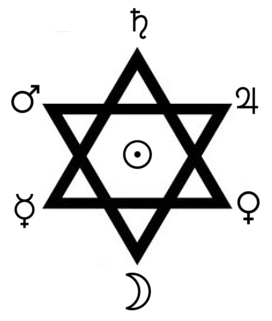
Visualise a Hexagram burning at your chest. This can be the GD Hexagram, or just white.

“And within me shines the Six Rayed Star”

Visualise a brilliant column of light shining within you, travelling infinitely upward and downward.

Finally, repeat the Kabbalistic Cross (Part III)

Thus concludes the well known LBRP.


Uses of the Pentagram Rituals

As we saw, this was the banishing ritual. In order to do the Lesser Invoking Ritual of the Pentagram, all we’d need to do is replace the banishing pentagram of the Earth with an invoking one (starting at the top point, moving towards the bottom left point). While the LBRP is a general banishing, the LIRP is a general invocation.

The reason the Earth pentagram is used, is because it is the lowest element, and thought to “contain” the other 3 elements within it. This is also why it is a white pentagram (if we were to invoke Earth separately, we’d use green and black pentagrams).

Many magicians will start the day with a LIRP, and do an LBRP before they sleep. This draws in spiritual energy to start the day off, and ends the day by clearing all energies from their mind and environment. It’s not too different from working out in the morning, and meditating or reading a book before sleep (or…drinking coffee in the morning and alcohol at night).

You can try this out for a week or so, and see how it works.

I want to provide a Initiation ritual that utilises the Egyptian gods along with the Invoking ritual of the Pentagram. It is based on a Sumerian ritual, but I always found the Egyptian deities resonate more with hermetic and kabbalistic work (for ME personally).

This ritual is to be every single day until the effects are felt, and serves as a simple initiation into the Hermetic tradition. It also draws in energy, so it is a good ritual for anyone who works with pagan, thelemic, kabbalistic or hermetic magick.


The Egyptian Initiation Rite

For this, all you need is a glass or cup, filled with water.

I’d suggest doing it in the morning, after bath/shower.

All the words given in bold capitals must be vibrated. Vibrating means saying the word with a deep, resonant voice, almost like a hum or song. When we vibrate magickal names, we draw the breath from within the belly and chest, and it will feel like the word is “vibrating” the whole body.

The rest of the words should be stated with a firm and clear voice, without any fear of being heard or judged. This ritual is simple, but very powerful when done right.

Cross of Ptah (Part I)

Face EAST.

Visualise a brilliant sphere of light above your head, about 12 inches in diameter.

Reach up, and draw down the light to your forhead.

Say “The world was created..”

Now touch your heart center, visualizing the light travelling down your body in a column, to form a sphere under your feet.

“…by the thought of the Heart”

Now touch your right shoulder, forming another ball.

“Life was given..”

Touch your left shoulder, drawing the light across.

“…by the magic of the Word”

Clasp your hands, and say “Amen”

Invocation of the Gods (Part II)

Now, trace an Ankh (clockwise for invoking, counter clockwise for banishing) of the Earth in the East.

Vibrate RA-RAURET

Turn to the South, with your fingers still outstretches, tracing a circle of light and draw the Pentagram again.

Vibrate HAUHET-HEH

Continue to the West, and do the same.

This time, vibrate NAUNET-NUH

Continue to the North, do the same.

Vibrate TA-TENEN

Continue to the East, closing your circle of light.

Now say the following:

“To my right, AUSET”

“To my left, NEBET-HET”

“Before me, ASAR”

“Behind me, AUSET”


Each time, visualise the mighty forms of the respective deities appearing in each direction, holding an ankh in one hand and the wajded staff in the other (although it is entirely up to you how you want to visualise them. Go with what feels natural)

Spread your hand to either side, and procliam:

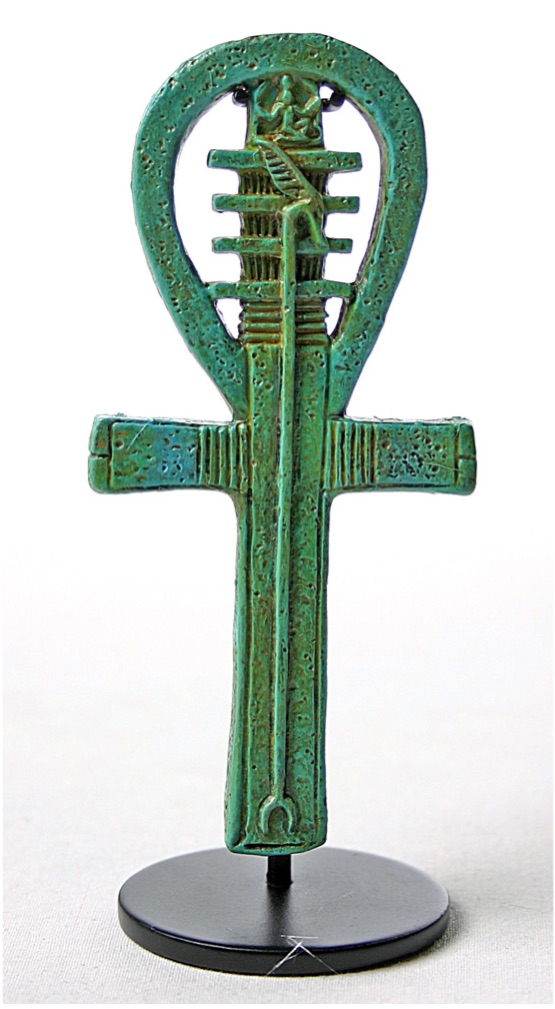
“For about me flames the Living Ankh”

Visualised the circle you traced becoming a sphere around you. The top half is a dome of brilliant pale sunlight, and below you is a dome of black, earthy ground. In the center, standing tall, is the Ankh

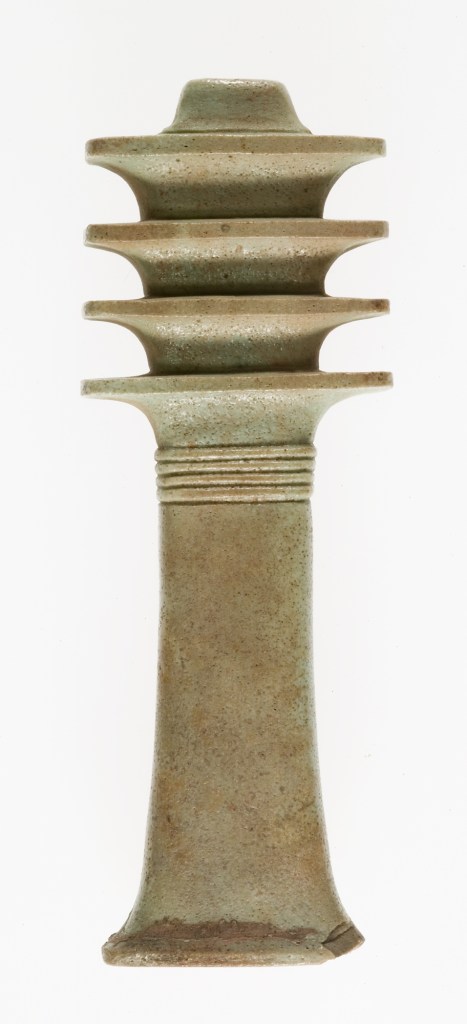
“And within me shines the Eternal Djed”

As you say this, cross your arms across your chest, and visualise the Djed shining in your entire being, and a beam of light travelling infinitely upwards and downwards.

Blessing of the Water (Part III):

Take you glass/cup/goblet of water. Move to the Easter quarter, right in front of you. Here, you had invoked Tehuti. State:

“Lord Tehuti, hail unto thee! I ask for thy blessing in my life, and the path of High Magick”


Pause a moment, then walk clockwise to the South (where Heru is invoked), and repeat the same recitation to him. Then do the same as you continue to the West and finally the North, making your prayer to Auset and Nebet-het. With each recitation, visualise the glass of water glowing brighter and brighter with light.

Now return to the center of the circle, and hold out your glass, visualising it containing bright, burning white light:

“Within the elixir shines the eternal light!”

Visualize an Ankh glowing brightly within the water.

“And within me dwells the eternal life!”

Consume the water, visualising the white brilliance entering your body, and filling your whole being with the same bright light.

Now, repeat the Cross of Ptah (Part IV) and end the ritual by bowing down.


Meaning of the Ritual

The ritual may sound long, but the whole thing will likely take little less than 5 minutes, and it probably took me longer to write it than it will take to perform it.

The speech at the beginning is a homage to the primordial creator god Ptah, who spoke the cosmos into existence (much like the God of the old testament).

The four Pentagrams utilize spiritual concepts.

Amun, the hidden Godhead, and Ra, the highest deity and God of Light. Their compounded form Amun-Ra represents the beginning of all things.

Heh is the personification of infinity, or the flood of Chaos that existed before the beginning of the world. Hauhet is the feminine form, while Heh is masculine.

Nu is the primordial watery Abyss, from which all life first emerged. It is the cosmic womb, and Naunet is its feminine form, while Nun is masculine.

Ta-Tenen is the primal mound, or the first piece of land that emerged out of the waters of chaos that filled the abyss, at the behest of the godhead. Upon this mound, the first Djed was erected and Time began.

Aten refers to the sun-disk, and the light of the heavens. Aker is the name for the kingdom of Matter.

The Ankh is the symbol of life, and it is carried by all Egyptian gods. The Djed is a symbol of the indomitable Will. Djed and the Ankh represent the male and female principle respectively.

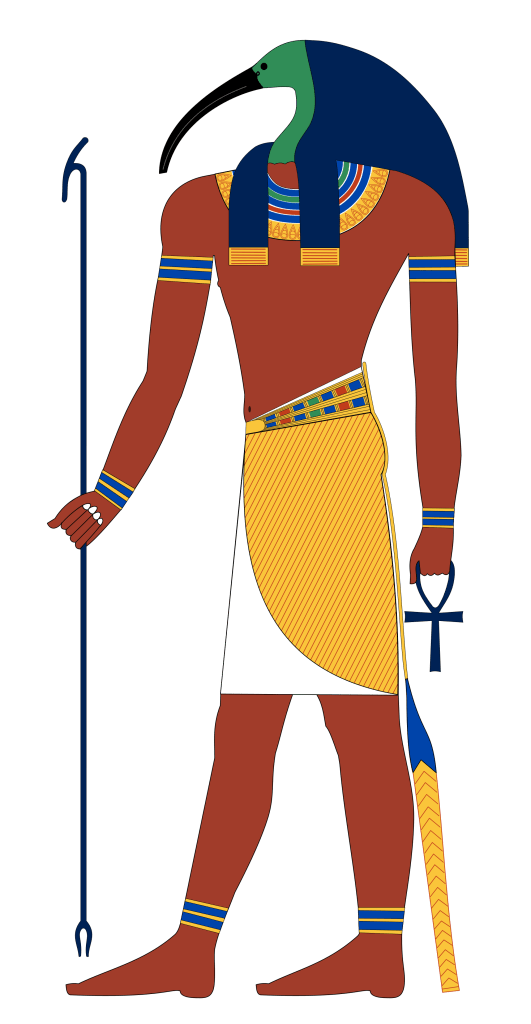
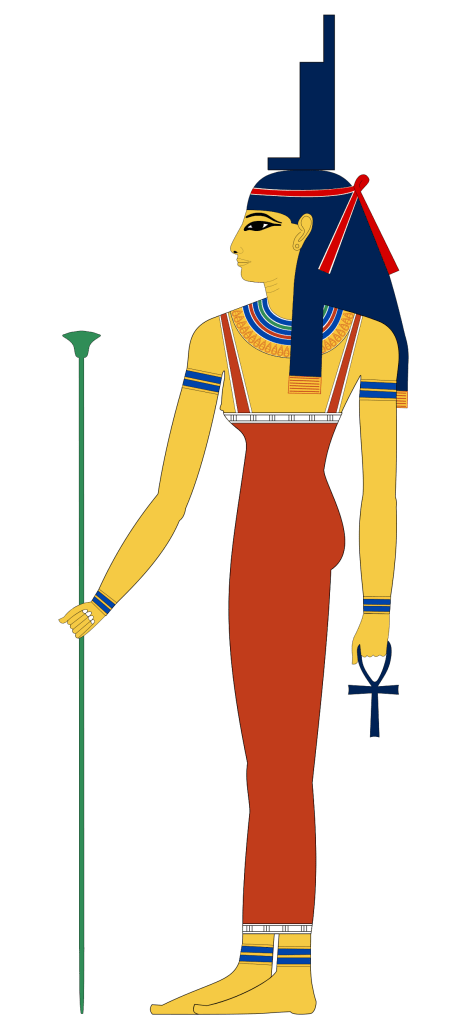
You may know the four deities Tehuti, Heru, Auset and Nebet-het by their more common Greek names: Thoth, Horus, Isis and Nephthys respectively.

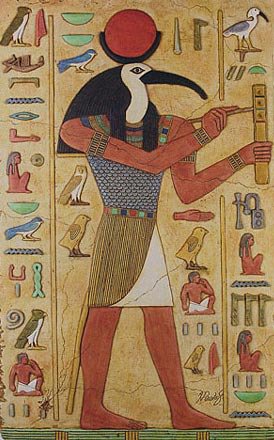
Thoth is the God of Writing, and the celestial scribe. He is the ruler of Air. He may be visualised as having the head of an Ibis or a Baboon, with glowing pale skin, as if made of moonlight, with similar eyes. His garments may be seen as plain and white. On his head is a crescent with a sun disk.

Horus is the God of War, and the avenger. He is the ruler of Fire. He may be visualised with the head of a hawk or falcon, with burning red skin, as if made from flames. His garments can be seen as having gold or bronze armour plates. On his head if the double crown of ancient Egypt.

Isis is the Goddess of the Fertility, and the cosmic mother. She is the ruler of Water. She may be visualized as a beautiful woman, with golden, glistening skin, as if made of liquid metal. Her garments can be seen as shimmering with multicolored rainbow light, or as deep blue, and embedded with precious stones. On her head is the throne of Egypt.

Nephthys is the Goddess of Night, and the patron of both chilbirth and death, and also magick. She is the ruler of Earth. She may be visualised as a younger woman, with dark black skin, as if made from fertile soil. Her garments may be seen as simple green/brown robes with a golden trim. On her head is a pillar.

Reference for the Sun disk on the head of Thoth, which isn’t given in the previous image.

When we make the crossed sign across our chest, we pay homage to Asar, known more commonly by the Greek name Osiris, the King of the Gods and ruler of the Duat (underworld/realm of the Gods). He rules Spirit.

Initially, there may be some resistance to the daily ritual. As with any new habit, it will take some time to become natural. But it’ll happen eventually.

Also, I’m aware that some of the incantations and recitations may seem bit clumsy to some people, so feel free to reword them in a way that makes sense to you. As long as the general tone and contents are retained, how you word it is up to you.


That’s all for now. I’m working on a bunch of stuff and I’m really excited to put it all out. I’ve got a lot of stuff regarding Indo-European magick, I want to talk about next. Look forward to it!

Until Next Time
~White Raven

Making Real Fairy Salve

Hello, and welcome back.

First off, I want to make a quick announcement. Thank you to everyone who purchased The Tree of Life: A Beginner’s Guide. The sales have been good enough that there’s a good chance I will release another e-Grimoire before the end of the year.

I understand that these are difficult and confusing times for some, and as far as I’m concerned all this will continue for at least several more years. This first book was introductory, but from now on I shall focus more on practical magick that can be done to improve one’s life and find one’s path.

But let’s move to today’s topic: Fairy Salve, and how to make it for spiritual and occult purposes.


The Story of the Fairy Ointment

The idea of “Fairy Salve” or Fairy Ointment comes to us from English and Celtic folklore. It’s essentially a folktale.

Like many other stories of its kind, it was most likely the result of strange encounters with some kind of occult phenomena.

There are many variations of the story, but in general it goes like this:

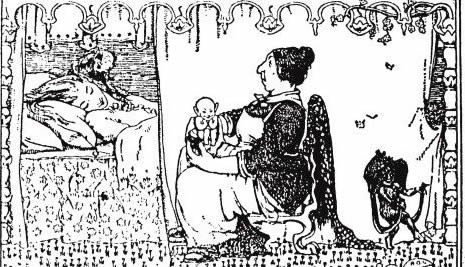
A nurse/midwife is visited at midnight by a strange looking man at her doorstep. He tells her that his wife is too ill to give birth alone, and he needs her help. The midwife is suspicious, but goes along with him in his horse drawn carriage, to his home.

There, she helps deliver the child, and cares for it while the mother recovers. She is instructed by the mother to rub a certain ointment on the baby’s eyes when it wakes up.

In some versions of the tale, the baby is anointed all over its body. Anyway, the baby opens its eyes, and the midwife notices his pupils are large and oddly shaped, almost like slits. But does as she was told, rubbing its eyes with the ointment. Either by accident or out of curiosity, she rubs some of it on her right eye, and immediately her surroundings change.

The small cottage is transformed into an elaborate or luxurious castle. In some versions, it turns into a dank (haha) cave. The midwife sees the child and its mother have turned even more beautiful (or ugly, in the cave version). She sees the baby’s siblings, who also have a strange appearance, playing around and doing all kinds of mischief, and realises she is in the home of pixies.

She doesn’t say anything, and when the father returns she demands to be taken home immediately. She sees the horse that draws the carriage is now pitch black with burning eyes. Upon returning home she is given a large payment. Some days later, she is at the market and sees the strange man, tha father of the baby, at the market. He’s taking whatever he wants from various different stalls, though no one seems to notice.

She immediately calls him out on it for stealing, and he is surprised by this. He demands to know if she can see him, and she says yes (famous last words). In response, he accuses her of stealing as well, and getting involved in things that aren’t her business. Reaching out, he touches the affected eye, saying she wont be seeing fairies anymore. Her right eye is then permanently blinded.

Some versions of this story also involve the nurse being kept prisoner by the fairies until she is recused by her husband. In other versions, she finds the salve in the home of a suspected witch, and later finds the witch’s husband stealing at the market, who then blinds her.


The Fae and English/Irish Folklore

To make fairy salve, it’s important to understand the context of this story. The main takeaway is that the Fairy Salve was believed to be an ointment that helped you see spiritual or otherworldly creatures. From the story it seems even the creatures themselves needed to use it, which is interesting.

Generally speaking, you may be familiar with the friendly and helpful fairies that appear in Fairy Tales, such as those in Cinderella or Snow White. However, all of those stories are German. In this case, we are not referring to the Fairies from the German “Fairy” tales.

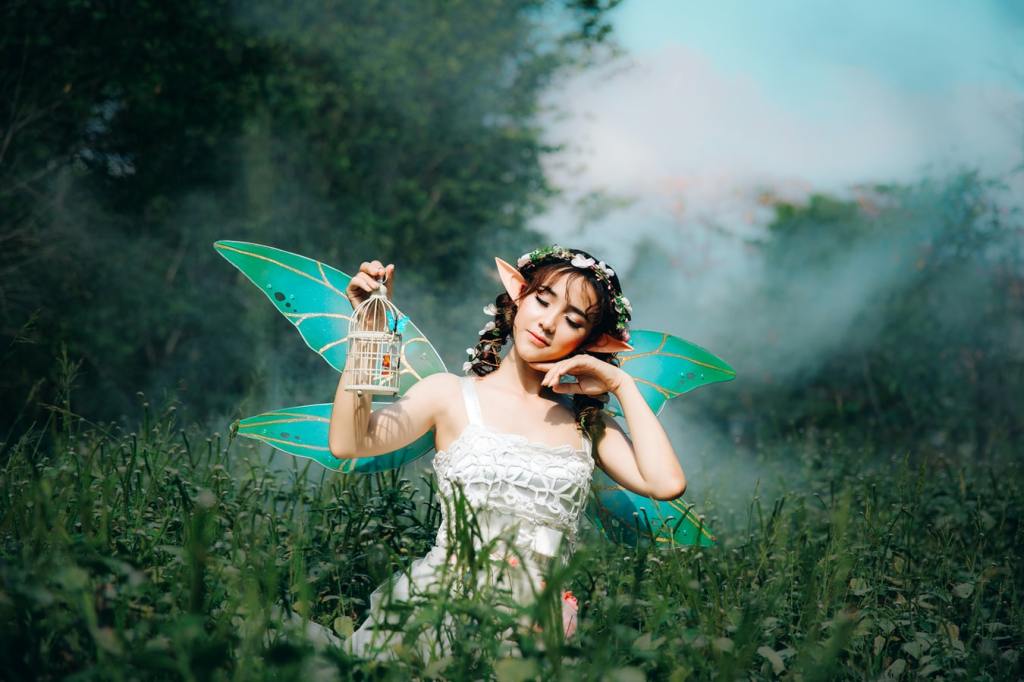
Then you might be thinking of the Elves, Dwarves, and other such mythical creatures, with pointed ears and a proud disposition. However, those are from Norse mythology, and this is not the place to get into those.

In Irish and English folklore, the word “Fairy” essentially referred to Spirits that lived alongside humans. This is not referring specifically to good or bad spirits, but rather a vast range of creatures. These are similar to what the Greeks called Nature spirits, or what the Japanese called Ayakashi, and in India they are called Yaksha. While the Norse use a different system of classification, some of their spirits are part of this category. The same can be said for the Arabic Djinn.

Put simply, these are not Gods, nor Demons, nor Angels. In Magick, they are often given the title of Elementals. The main thing to remember is that they live alongside humans in this material plane, not in some place beyond.

The idea of such things has been around ever since humanity started living together in settlements and communities, and staying separate from Nature. At the edge of Civilisation, where human life met the raw forces of Nature, people had strange experiences and thus the idea of the nature spirits came about. Many legends and folk tales refer to a time when these spirits lived with and mingled with humans, but then the two groups fell apart (referring to how humanity became separate from nature). In most cultures, this referred to the spirits of the trees, rocks, deserts, rivers and mountains. Some could be vast, dwelling in mountains, some small, dwelling in grains of rice.

This belief is called Animism, and was/is a part of ‘primitive’ cultures: the idea that everything has a spirit of it’s own. In other cultures, particularly after organised religion came about, people only began to think of these spirits as dwelling in wild places, such as deep in the desert or in unexplored parts of forests. Whether they are friendly depends on the culture, region and geography.

In almost all cases, animals themselves were also considered to be a part of this category. The most well known examples are Native American and Siberian shamanism, where animals are just as much spirits of nature as any mythical creature. To us in our modern societies, this may sound strange, because we have documented animals so well, and even tame and breed them regularly. But to our ancient ancestors, most animals were as strange and magical as any fairy or nymph, not to mention the large number of dangerous wild animals that could attack and kill humans.

Even now, look at the kinds of things we are discovering in the deep sea, which are completely strange and contrary to our expectations. Look at videos or pictures of these things, and see if you don’t feel a sense of mystery, wonder and even fear.

Various cultures then, established all sorts of rules and regulations about how to deal with Nature Spirits, and how to respect their boundaries. This was not mere superstition, but also served to protect people from wandering into the territory of bears, tigers or lions. It kept them safe from various natural phenomena they did not understand. For example, to keep people indoors after night, away from forests and lakes, or to have them stick to roads and not venture off course, to be wary of strangers, to avoid the spread of disease etc. In magick we understand that “as above so below”. Any event occurring on the material plane has a spiritual counterpart, and you will see that all these things that people were afraid of were indeed “Spirits of Nature” .

To those who like films, I highly suggest the 2004 film called The Village. Don’t read any reviews or summaries, just go and watch it. It may give you something to think about.

In England, Scotland and Ireland (and Wales), these were often called the ‘Fae’ (fair folk). “Fair” here means beautiful, not ‘pale’.

Some fae were helpful, some were malicious. The most common distinction I’ve found is between “Night” and “Day” Fae. The Fae/Faery played an important role in the daily lives of people (even more than Gods) and therefore having a good relationship with them was important, as well as keep them at a distance. While the Fae were helpful, they could also be mischievous. They are forces of Nature, and i’m sure I don’t need to tell you that Nature does not always act as humans would like it to.

Painting by Floris Didden

The fundamental thing to understand is that the Fae weren’t ‘good’ or ‘bad’, but that each things had its own purpose, and acted according to its nature. That is perhaps the greatest difference between modern and ancient humanity. Our ancestors lacked the means to control their lives and environment the way we can. As a result, they were not so arrogant and proud. They understood that Nature had its rules, and they had to live according to it. Things like fire were helpful, but if used incorrectly, they would burn you. Things like controlled gas stoves (and now electric ones) have been around for a century or so, but humanity have walked the Earth for over 200,000 years in its present form. When people were blessed with good fortunes or wealth, or when they had a good harvest, it was because they had been blessed by fairies. But when children went missing, when people died of disease or got lost in the woods, it was also fairies.

After the advent of Christianity, the Church struggled to reconcile these beings with their Scripture. It is well known that while several regions of Western Europe embraced the Chruch, the Irish stubbornly insisted on bringing along their pagan legends and folk traditions (ironically, hundreds of years later it would be the opposite, and the Irish would be hated for refusing to leave the Church and join the protestant cause. Ah..the joys organised religion).

The best answer the the Priests could give was that the Fae were somehow “fallen” creatures, similar to fallen angels, and that they must be feared.

Now, it must be clear why the Fairy Salve story has different versions. The version where the pixies are beautiful and live in a castle is probably the original, while the one where they are ugly and live in a hovel is post-Christian.

We could go on and on, but this is a very extensive topic. So I’ll cut it short with some thoughts on a certain famous occultist you’ve probably heard of: William Shaksepeare.

Yes, Shaksepeare was a magus. He was also associated with John Dee (yes, THAT John Dee, noted astrologer and alchemist, who created the Enochian language and tablets along with Edward Kelly, and who served as a spy for Queen Elizabeth).

You see, Shaksepeare was quite a radical individual for his time (like all Occultists). Though today we think of him as ‘sophisticated’ and his works are considered ‘classics’, they weren’t so when he was alive. The language he uses, which now is seen as posh, was actually a bit crude for his time. While he wrote a lot of historical plays, he also threw in spirits, ghosts and other random shit. He was like a 14th century Kurt Cobain. Naturally, it was this radical spirit that made so many love and appreciate his work. Contrary to what some may tell you, society does value and respect free thinkers, especially those who produce creative works.

To anyone who’s read his work, you can see the very clear presence of fairies. The most notable is probably The Tempest, which straight up has a sorcerer who has bound an elemental spirit to him. It is strange to say, but we don’t actually have many written records of what medieval British and Irish people thought of Fairies. Our modern perception of the Fair folk is greatly influenced by people like Shakespeare. This includes the notion of Titania and Oberon being the King and Queen of Fairies, of their general humanoid appearance and attitude.

Honestly, to make a full and complete deconstruction of the exact sources of modern fairy lore would be quite difficult, to put it lightly, so let’s cut it here.


Creating Fairy Salve

I have created this substance only twice. The first was by a pagan method (I was still new to magick and very experimental), the second by a kabbalistic. Both worked extremely well, and I shall outline them roughly.

What is the purpose? Well, it is both a ‘offering’ to be made to elemental spirits, as well as an anointing oil that can aid psychic perception during ritual. Simply put, it will help you sense spiritual phenomena during any sort of spiritual working. This idea is neither new nor limited to the British Isles, and there are several medieval grimoires that call for anointing the temples and eyes before a magick ritual (most commonly the Oil of Jerusalem, which is a certain type of enchanted lamp oil).

The Pagan Method

The pagan method will appeal more to neo-pagans, shamans, witches and the like. It takes longer, and can be easily personalised.

The basic idea is to saturate an oil with herbs, and bless it with the forces of nature. Since elementals/Fae are meant to live alongside humans, this recipe calls for herbs that have been collected from one’s own garden. It doesn’t matter which herbs you pick, but ideally it should be something you grow. Maybe choose the oldest plants you have, or those that appear to have a magical connection. You may also look into the folklore of your region, to see if any herbs or plants stand out as being associated with nature spirits.

You need to pick a time for this, and I would suggest the full moon. Or just the early morning of an auspicious day. Select a certain number of herbs. Perhaps 7 different varieties, and 3 of each?

Next, you must choose the oil. Since we are trying to make a ‘salve’, it’s a good idea to choose something that is more like a paste rather than a complete liquid. Coconut oil or ghee (clarified butter) are good, because they harden when cold. If you plan to burn it as an offering, make sure it’s flammable. If you cannot get these, you can use any normal oil. However, I do suggest going to the effort of procuring these, because this and the herbs are the only two ingredients needed, the rest is magick!

You may, if you want, add some salt. An enchanted salt, or mineral salt is good. Salt is used by many neo-pagans for protection from negative influence.

Put the chosen oil in a steel container, and then put it in a larger container filled with water. This is just a general guideline for heating any kind of oil. If we put the the container with the oil directly on the fire/stove, it will ‘cook’ the oil. In some cases, it may even vaporize the oil. Therefore, we use a water bath, to avoid burning/cooking our ingredients, and also maintain the temperature at 100 degrees Celsius.

Fun fact: This set-up, though very common in modern kitchens, is said to have been discovered by an alchemist. It was a Jewish adept from Alexandria called Mari the Prophetess (1st-3rd Century C.E.). Hence, this set up is known in alchemy as the balneum-Mariae (Bath of Mari).

Bring the water to a boil and allow the oil to heat up. As it heats, you add your herbs, either grown up or just broken up by hand. You can say a prayer at this point to any Gods of your choosing. When I first made it, I had prayed to Diana, a form of Venus and a prominent pagan goddess, and Pan, an important pagan deity for all works concerning nature and the wild. Diana is also considered to be the Goddess that is worshiped by the fair folk themselves. I do not remember exactly why this is, but I think we have Shakespeare to thank for this as well. Use a wooden stirring rod for mixing (never use iron. Steel is acceptable, but not ideal). Mix slowly, on a low heat.

Finally, when you feel the herbs have been fully saturated with the oil (10-15 minutes of heat), take it off the heat and leave it to cool. Do not cover it until it is cool. You may cover it with a cloth, if you have to.

The first process is done. The mixture has been prepared using the four elements (herbs picked from the earth, heated with fire and water, and cooled by air).

The elements are done, and we move on to Darkness. Put the mixture in a closed, opaque contained, and leave it sitting in a cool place where it will not be disturbed or be exposed to the light. Since this is a pagan method, you can also thrown in any consecrated crystals or other objects into this.

Here, the substance is blessed by the forces of darkness, whose blessing is essential so that obstacles and challenges are not faced in the future. Ideally, this should can sit for at least a week, but probably for longer. You’re waiting for the full moon. However, let it be no longer than a month, to avoid rotting or decay.

On the day of the full moon, you shall filter out the herbal components, and put the oil in a clear glass jar (plastic works too). These are no longer needed and can be discarded (ideally thrown back into the soil to decompose). Be sure to remove any stones, crystals or object you’ve put in.

Now begins the consecration by the four elements and Light (both of the Sun and the Moon). On the night of the full moon, put this jar in a container of water, and leave it outside or by a window. The water should ideally be from a natural source, such as a spring, river or from rain. When I was doing it, I did a ritual to make it rain, which worked (this was the very first time my magick had worked on such a grand level, and the single most important event that cemented by spiritual faith permanently). If not, then get some drinking water (do not get water from the bathroom sink). If you have enough, this water can also be used for the initial water bath.

It’s good if it’s directly exposed to the moon all night. But, since this is difficult for many people, it’s okay as long as it is outside or by an open window, where it can be hit by the wind. Say a prayer to the Moon if you want, and to the Fae of the Night to bless it.

Here, the salve is being consecrated once again by Air and Water, as well the Moon. Leave this overnight, from Sunrise to Sunset.

The next Day, at Sunrise, take this jar out of the water and put it in the ground. Do not bury it completely, and make sure the top is sticking out. You can also use a planting pot, or just a container with dirt in it. You also need some incense. The way I did it, is half buried the jar in an empty pot, then covered it with a larger plastic container with a incense cone next to it. This ensured that the smoke actually touched jar instead of just blowing away. Leave this in the sunlight until sunset. Call on the Sun and to the Day Faeries for blessing it.

The salve is now being consecrated by the Sun, by Fire (incense) and Earth.

When I first made this, I was lucky enough that the Full Moon was on a Monday, and immediately following a Summer solstice on Sunday. The second part of the consecration was on Tuesday. Don’t obsess over timing, but it’s good if you happen upon such an auspicious time.

Now, at sunset you take your jar, draw upon it a sigil that represents spiritual sight, or something else that is relevant. You’re free to create this sigil however you want, or choose a symbol that already exists and is important to you. You may even use the symbols of any Gods you worship.

At night you will conduct a ritual where you shall call upon the power of the forces of nature to bless and complete the Fairy Salve. A good set of deities is Diana, Pan, Titania and Oberon, and maybe even Gaia, the Earth Mother. Titania and Oberon may be seen as essential, since the substance is made by their authority. It’s a good idea to give some offering as well (candles, milk/honey, fruits etc). State the purpose of the Fairy Salve, and you’re pretty much good. When the ritual is done, thank the forces involved and clear your space. Your Fairy Salve is done. Use it as an offering, and anoint your temples and eye lids before a ritual.

As we discussed before, a good way to offer it is to burn it in a traditional oil lamp.

The Kabbalistic Method

For this method we are going to follow a similar, yet different approach. It is better for those who want to make the Salve more quickly, but don’t mind putting in more work. Ideal for kabbalists, thelemites, rosicrucians and hermeticists.

The Pagan method has relatively simple instructions, because much of the work is begin done by the spiritual forces of nature over a longer period of time. Here, the work is done mainly the the magician him/herself.

Once again, we begin by collecting the herbs. Once again, it is good to collect garden herbs, or herbs in your kitchen. We shall select 7 different varieties of herbs, once for each planet.

For this you must do your own research, and see which herbs are more commonly available in your region. I could give you an arbitrary list, but it would be better to make your own list. You can easily find the planetary rulers of most common herbs online. Ideally, pick herbs which has some association with psychic senses, nature spirits or magick. The variety of herbs needed for fairy salve are what make it more complex than your usual magick oils for things like prosperity or love, which usually only need a few herbs of any single planets.

Let’s say this is too daunting a task. In that case, you may select only herbs associated with the Moon, since the Moon rules psychic powers and visions. You also need Frankincense (or some other sweet smelling resin that can be melted). Just look for powdered frankincense, which should be easy to find, as it is commonly used as incense. If you can’t, do magick to get it.

Next, we pick a base again (ideally coconut oil or ghee, or something similar, which hardens when cold. This is not compulsory, but these are easier to rub on your eyes. Whatever you pick, ensure it smells nice and is pleasant. After all, why would you offer something repulsive to the fair folk? So no, don’t go busting out the mustard oil). We do this on Monday, in the hour of the Moon, during the waxing phase.f.

We now prepare it again, as we did before, in a water bath, adding in our broken up ingredients into the heating oil. As we stir it, we visualise white light comic from above and saturating the mixture.

We once again let it cool uncovered. The mixture has once again been blessed by the four elements, and you must offer a silent prayer and thanks, for these four elements make up the mechanistic Universe as we know it.

You shall take the mixture and pour it into an opaque container, so that no light may touch it. Having done so, draw upon it the symbol of Saturn, the bringer of Death, the collector of Dues. Place it in a cool dark place, and visualized a deep and complete darkness surrounding it, purging all that is unneeded.

Planetary symbols for your reference. These will be used throughout the Kabbalistic method. Beginning from the top left, the symbol of: Sun, Mercury, Venus, Moon, Earth, Mars, Jupiter, Saturn, Uranus, Neptune, Pluto

The mixture shall now be left untouched over night, where the herbs shall give up the last of their essence. The next morning, awaken at sunrise and thank the lord Saturn. Erase the symbol from the container, and open it. With a solemn and serious heart, filter out the herbs. Heat the mixture again in a bath, and now add it your frankincense. Let it remain in heat for as long as it takes the powder to melt dissolve. Do not add large pieces of frankincense, as these will never dissolve. Everything must be finely powdered. When it is done, take it off the heat and pour the mixture into a clear glass jar and seal it shut. This shall serve as the philosophic egg, where the mixture shall hibernate. Be sure not to add the mixture if it is too hot and the glass is too cold, since the glass may crack.

Take the mixture outside and lay it to rest in Earth. Do no bury it completely, and let it’s top stick out, so that it may breathe the life giving Air, and lay before the radiant light of its father (Sun). In the soil around it, trace an upward pointing triangle (Fire) and draw on each point, the symbol of the Sun, Venus and Jupiter. Pray that, by their benevolence, they may awaken the spirit within. Now you shall mourn it’s passing, and offer a silent plea to the Spirits of the Day, to impart their blessing on it.

At sunset, you shall go again to the place of the burial, and erase the planetary symbols. Now trace a downward triangle (Water) around it, and draw the symbols of Moon, Mercury and Mars around it. Pray that they, by their harshness, by invigorate the spirit within the salve, and purge it of all impurities. Offer a silent plea to the spirits of the Night, that they may remove any obstacles in the working to be done. The ointment is in darkness again, but this time it has the guiding light of its Mother (Moon). Now leave with a hopeful heart, praying for the success of your working.

The next morning, awaken when you may with a happy and joyous heart. Wash your body and go to the place of burial. Remove any remaining symbols and offer heartfelt gratitude. Take the jar and clean it by submerging it in water (making sure no water gets in), and then cleanse it with incense, thus removing both physical and spiritual impurities.

Draw upon it the following symbols: Around the circumference, you shall draw the symbols of the four elements. At the bottom, draw the planetary hexagram, and on top of the lid, draw a pentagram. On either side of it, the symbols of Uranus and Neptune, and the symbol of Pluto at the bottom. Reflect for a moment, on a purpose of this ointment.

Now do a ritual of consecration. Begin with the lesser banishing ritual of the pentagram, and the banishing ritual of the hexagram. As you say the last words, IAO, visualized brilliant white light streaming from the heavens into the jar, and saturating the mixture within. You may also use any other rituals that are used in your own tradition. These are simply the ones I use.

Close your eyes and meditate with the jar in hand, and make a prayer to the Elementals of the four quarters. Pray to the the elementals of Fire and their Ruler, and trace the Invoking pentagram of Fire with your finger on the jar. Do the same for Water, Air and Earth. The spirits and Kings are named thus:

ElementName of ElementalsName of Ruler
FireSalamandarsDjinn
WaterUndynesNycksa
AirSylphsParalda
EarthGnomesGhob
For example, “I call upon thee, oh great Paralda, to bless this jar of ointment. I call upon thy kin, the Sylphs, to lend me their power!” Then trace the Pentagram.

The Pentagrams traced should be visualised as red, blue, yellow and green respectively. When you feel the ritual is done, give thanks and welcome the elementals into your life. As them for their favour, and give offerings often. Warn them regarding mischief or harm towards any living thing.

Now give your heartfelt thanks, perform the Lesser Banishing again and you’re done.

Now you may make a small offering of thanks that very night. You can leave some food or drink outside in your garden and balcony, and call on the Faeries/Elementals to partake. Leave it overnight, throw it out the next day. To test the efficacy of your Ointment, apply some on your temples and eyelids. You should feel its power immediately, and enter into a light trance. If you do not feel it, then it is possible the mixture is not charged enough. It can be charged by leaving it on an altar or meditating on it. Remember, if your psychic senses are not fully developed, you may not immediately see spirits. However, this will strengthen your psychic sense greatly. Do not obsess over being able to physically see the spiritual beings you are invoking. If it has to happen, it will happen in time, when you are ready.


In Conclusion

I know, the rituals seem extensive, but they’re actually a lot quicker to do. It actually takes longer to describe them than do them. You’re free to omit any parts you feel like, or add any of your own, or mix and match as you please. It can be as simple, or as elaborate as you want.

I mean, you could simply take some random oil, dissolve some moon herbs in it, bless it and call it a day. But the amount of energy put into magick determines its result. If you can muster up all the energy needed with a simple prayer, go right ahead. But most will require rituals to build up the same energy. Like everything on this blog, the process if described to be extremely friendly to people who are new to magick. Those who are more proficient are free to use what they need and discard what they don’t (although going through the whole process will only generate more energy).

I mean, the second time I made the ointment, I did not do any prayers or mourning, nor did I trace the triangles. That’s because when I buried my jar, I was able to mentally call on the aid of the planets. But for many others, the visual aid will help greatly. Some people may even go a step further, and place objects associated with the planets around the jar.

It is up to you when you make offerings to the Elementals. You can use the Fairy Ointment during any sort of ritual where you need to invoke them or their rulers. It may be a good idea to make an offering of this ointment every Solstice and Equinox. At least on the both Solstices.

So there you have it, I have finally answered what is probably the very first question I was ever asked by a reader all those years ago.

Until Next Time
~White Raven

New Book Release | The Tree of Life: A Beginners Guide

Hello, and welcome back.

I’m very pleased to announce the release of my first book on Magick. I present to you The Tree of Life: A Beginner’s Guide.

It contains a wealth of information regarding the Sephiroth, Kabbalah, the Tree of Life, Astrology, Sacred Geometry, the Qliphoth and much more.

Let me start at the beginning. I am a Hermetic Kabbalist, and have been practicing Magick for several years. I’ve been sharing my thoughts and experiences here since 2015.

Over the years, lots of people have asked me various questions, the most common being how to get started with magick and spiritual work.

For those who want a start, this book is the prefect thing for you. It will familiarise you with the basics of High Magick, and in particular the Tree of Life and the philosophy of Kabbalah.

So, I bring you some of my best work yet. This book has gone through various iterations, as I’ve compiled all my knowledge regarding Kabbalah, and the Tree of Life in particular, and tied it all up in a articulate fashion.

What’s the point if you have to spend decades pouring over books just to get started? And let’s be honest, not everyone speaks English as their first language, and even those who do may find the writings of eccentric English noblemen to be difficult. Don’t get me wrong, these writers were brilliant. Some of the most important people who lived in the last century. But, it is time to make the knowledge more open. The Age of Aquarius demands it.

Kabbalah is a beautiful and sacred art, and has usually been kept hidden. In this book, I have explained all the details and symbolism in plain and clear language. I wanted to write something that anyone, even a complete novice to Magick, could read and understand. It will provide a clear and complete understanding of the Sephiroth, and exactly what they are, outside the usual framework of religious dogma. I have tried to cover all the bases, and touched on astrology, alchemy, and sacred geometry as well, and how they relate to the Sephiroth. As far as I’m concerned, understanding the Sephiroth is the key to all practical magick, as well as life in general.

It is my great hope that this book will answer many, many questions that people have, and especially help those who want to practice ceremonial magick and have a thirst for information that is not designed to mislead them.

I have also put in high resolution diagrams, as well as two different versions of the Tree of Life that can be easily printed on an A4 paper without loosing quality. I’ve made sure of this.

For the time being, I have decided to use Gumroad to release this book. If all goes well, you can look forward to more books on a variety of other topics. I am working on a conclusive method for Invocation and Evocation as well. That one might take me the longest time, but there is plenty more to Magick 😀

Head over to:

https://gumroad.com/betweenthepillars

You can also click this link here and go directly to the product page.

How does it work? You purchase it on Gumroad and then you get a PDF version of the book. If you experience any issues with the purchase, send me an email. As of now, it’s going to be an E-Book (maybe some day I’ll be fancy enough to sell physical books. But then again, I dislike being fancy).

And for those who have been asking for years now, don’t worry. The invocation of the Archangel Michael and the recipe for making Fairy Salve are going to be my next posts. I’ll touch upon how to cast a circle as well.

That’s all for now. Thank you for all your support and generosity over the years 🙂

Until Next Time.
~White Raven

The Best Way to do The Bornless Invocation

Yes. I know. This is the first time I’ve made 3 continuous posts without a 6 month gap between them. You must be so proud.

Before we get to today’s article, I have an announcement to make. This Full Moon, I’m releasing an E-grimoire, which will be the first of hopefully many on specific topics. It’s going to contain a lot of theoretical, and practical information along with diagrams. More on that later, but look forward to it. If you’re reading this after June 2020, chances are it’s already out. Check the ‘Books’ tab on the top bar.


On this blog I have two types of visitors. The first are people who are curious about the Occult or just starting out, and come by to read about my experiences with summoning demons, explanations of the pentagram or simple spells. Then there’s those who are experienced Occultists, who can put up with me rambling on and on about specific Sephiroth and Gematria values, and understand every word perfectly. At the very least, anyone who reads this blog has made the choice to learn about and hopefully practice the true magick of the Light, free of superstition, danger and shallow spiritual thrills.

What I’m writing about today may attract people who are so new to the Occult they don’t even know it’s the Occult. To them I say, keep an open mind as you read, and don’t stress about not understanding some things.

I know this because the Bornless Invocation was my first foray into the Occult. While I had some exposure to new age stuff before, it was with this ritual that I was exposed to names like Crowley, Mathers, the Golden Dawn etc. Until then, I only thought of spirituality in the hippie sense. I couldn’t even grasp the depth of what I’d stumbled on.

It’s a bit strange thinking back on it. How something that has become an integral part of my life came to me when I was bored and randomly typed “how to summon demons” into Google. Fate perhaps, or just luck.

Today I’m going to go over a brief history of this ritual, and then tell you the most efficient way to perform it, at least according to me.

A lot of information on it online is from dabblers and armchair occultists, because few real practitioners of Magick actually use it in ritual practice. But I’m one of them, so let me give a clear guide to it, without the nonsense.


What is the Bornless Ritual

I’m guessing most people, if not all, came to know of this ritual from the Ars Goetia, which is the first part of The Lesser Key of Solomon. If you google it, you’ll find a lot of websites that basically copy paste the same ‘definition’, calling it the ‘prliminary invocation of the Goetia’. While that’s technically true, it gives off the wrong impression.

This is the most commonly encountered version of the ritual:

“Thee I invoke, the Bornless one.
Thee, that didst create the Earth and the Heavens:
Thee, that didst create the Night and the day.
Thee, that didst create the darkness and the Light.
Thou art Osorronophris: Whom no man hath seen at any time.
Thou art Iabos:
Thou art Iapos:
Thou hast distinguished between the just and the Unjust.
Thou didst make the female and the Male.
Thou didst produce the Seed and the Fruit.
Thou didst form Men to love one another, and to hate one another.
I am Ank F N Khonsu Thy Prophet, unto Whom Thou didst commit Thy Mysteries, the Ceremonies of Khem:
Thou didst produce the moist and the dry, and that which nourisheth all created Life.
Hear Thou Me, for I am the Angel of Apophrasz Osorronophris: this is Thy True Name, handed down to the Prophets of Khem.
Hear Me: Ar: Thiao: Reibet: Atheleberseth: A: Blatha: Abeu: Eben: Phi: Chitasoe: Ib: Thiao.
Hear Me, and make all Spirits subject unto Me: so that every Spirit of the Firmament and of the Ether: upon the Earth and under the Earth: on dry Land and in the Water: of Whirling Air, and of rushing Fire: and every Spell and Scourge of God may be obedient unto Me.
I invoke Thee, the Terrible and Invisible God: Who dwellest in the Void Place of the Spirit: Arogogorobrao: Sochou: Modorio: Phalarchao: Ooo: Ape, The Bornless One: Hear Me!
Hear Me: Roubriao: Mariodam: Balbnabaoth: Assalonai: Aphniao: I: Tholeth: Abrasax: Qeoou: Ischur, Mighty and Bornless One! Hear Me!
I invoke Thee: Ma: Barraio: Ioel: Kotha: Athorebalo: Abraoth: Hear Me!
Hear me! Aoth: Aboth: Basum: Isak: Sabaoth: Iao:
This is the Lord of the Gods:
This is the Lord of the Universe:
This is He Whom the Winds fear.
This is He, Who having made Voice by His Commandment, is Lord of All Things; King, Ruler, and Helper. Hear Me!
Hear Me: Ieou: Pur: Iou: Pur: Iaot: Iaeo: Ioou: Abrasax: Sabriam: Oo: Uu: Ede: Edu: Angelos tou theou: Lai: Gaia: Apa: Diachanna: Chorun.
I am He! the Bornless Spirit! having sight in the Feet: Strong, and the Immortal Fire!
I am He! the Truth!
I am He! Who hate that evil should be wrought in the World!
I am He, that lightningeth and thundereth.
I am He, from whom is the Shower of the Life of Earth:
I am He, whose mouth flameth:
I am He, the Begetter and Manifester unto the Light:
I am He, the Grace of the World:
“The Heart Girt with a Serpent” is My Name!
Come Thou forth, and follow Me: and make all Spirits subject unto Me so that every Spirit of the Firmament, and of the Ether: upon the Earth and under the Earth: on dry land, or in the Water: of whirling Air or of rushing Fire: and every Spell and Scourge of God, may be obedient unto me!
Iao: Sabao: Such are the Words!”

First things first though. The Lesser Key of Solomon is a famous medieval grimoire of unknown origin, claiming to have been written by King Solomon himself, but that’s probably not true. It was very common for medieval authors of grimoires to remain anonymous, and attribute their books to legendary figures like Solomon, Moses or Christ. This was partly to protect their identity, but also to separate themselves from their work. Most magicians even today write under a pseudonym (including me), so that people can focus on the information instead of the person.

The book has five parts, although most people only know about the first, the Ars Goetia. This is a list of 72 ‘demons’ who allegedly helped King Solomon (a Biblical figure who was a great King of Israel) build his Temple at Jerusalem. The book gives their seals, descriptions and various rituals to summon them. The book was compiled in the 17th century, although it is based on many older texts, such as the works of Johanne Weyer, Henry Cornellius Agrippa and Eliphas Levi.

And that’s what the book was for centuries. However, in 1904, a man named Samuel Lidell Mathers translated this work, along with several others. Mathers is an important figure within the Occult, one of the founding members of The Hermetic Order of the Golden Dawn (i’m sorry for so many long names right off the bat, but the quicker we get them out of the way the better. Many of you will already be familiar with these).

Mathers was the first to translate and publish this manuscript, and it was edited by his then friend and fellow Golden Dawn member, and the well known occultist who rose to infamy: Aleister Crowley. At the very beginning of the book, Crowley decided to add a rather peculiar ritual: The Bornless Invocation.

A rare photo of Mathers and young Crowley together. This was when Crowley was initiated into the Inner Order of the Golden Dawn by Mathers.

Now, understand that this ritual was not part of the original manuscript. In fact, i’m sure the original medieval authors of the Lesser Key wouldn’t even have known about this ritual. But, it was not created by Crowley either. The Bornless Invocation was originally in Greek, although if you look at its contents, you’ll see it actually has Egyptian origin.

It was most likely created by Gnostics, a mystery cult in era of the Roman Empire which would go on to become Christianity. Many Gnostics would have been Greek, and were heavily inspired and influenced by the Egyptian and Jewish mysticism making its way into Europe. That would explain why, despite being Greco-Egyptian, it appears to have Abrahamic language that we see in Judaism and Christianity, and why it places an emphasis on Osiris, whose myths and symbolism served as a basis for the Gnostics to create their own symbolism and tradition. Also, for the sake of clarity, i’m referring to the early Gnostics of the Roman Empire, who were basically proto-Christians, not the Cathars who were around almost 800 years later.

It’s also worth mentioning, that in this version by Crowley, he added “I am Ank F N Khonsu Thy Prophet, unto Whom Thou didst commit Thy Mysteries, the Ceremonies of Khem“. Khem is the ancient name of Egypt, and Ankh F N Khnosu was a magickal motto used by Crowley.

In the older, Abrahamic versions, it is written as “I am Moshe Thy Prophet, unto Whom Thou didst commit Thy Mysteries, the Ceremonies of Ishrael“. Here, Moshe is the Hebrew name of Moses, and Ishrael is the fabled Holy Land of the Biblical Jews (not to be confused with the modern nation state of Israel. There is much overlap, but they’re not exactly the same thing)

The Gnostics probably used Jewish symbolism, but Crowley saw fit to make it Egyptian, based on its origin. As it should be obvious, this translation was made to be practical to ceremonial magick, and not necessarily accurate. Many linguists and historians have translated the ritual in various, more accurate ways since then, although none have the same flair as the GD version.

The dialect you see here is late Middle English, or at least, what people in the Victorian era (such as Mathers) thought Middle English was like. Hence why many words have suffixes, such as the term “flameth” instead of flames. Pre-classical English used to be language with almost as much beauty and intricacy as Sanskrit, Latin or Hebrew. This is the dialect used in many English versions of the Bible.

The reason Crowley chose to include this ritual in the Goetia, is because it calls upon the authority of the Most High. The term ‘Bornless One’ means that which is eternal, which has no beginning. In fact, a more accurate translation of the name would be “Headless One”. To us modern people, that name sounds scary. But to the Gnostics (and possibly ancient Egyptians), it meant something more profound. Having no ‘head’, means having no ‘Ego’. That which is ultimate and self realised.

The original prayer calls on Egyptian God Osiris (Asar). In the modern version, we see the term ‘Osorronophris’, which is a Greek distortion of ‘Asar un-Nefer’, meaning Osiris the Beautiful.

The Golden Dawn worked very heavily with Egyptian gods, so it’s clear to see why they would choose this ritual. It appealed to their highly Egyptian sensibilities and style of magick, while still retaining the Kabbalistic/ Gnostic imagery they were familiar with. Within the GD tradition, Osiris is often considered the highest God. Modern media presents him as some sort of underworld Deity. But when you realise that the ancient Egyptians believed the afterlife was under the Earth, not up in the Sky, this has much more significance.

Osiris was also the God of fertility (and Egypt was a largely agricultural society). The annual flooding of the Nile marked the Egyptian New Year, and it was linked to the rebirth of Osiris. But the most important thing for us, is that the Pharaoh was said to be the living manifestation of Osiris on Earth. Thus, he commanded authority over the entire Empire.

That’s what the Bornless Ritual is: authority. When you stand within the magick circle, and summon angels or demons, you do so with that authority. The performance of this ritual is the the proclamation of that authority, that has been granted unto you by the Divine (however you choose to think of it). Put bluntly: it is an Invocation of God, and in the magick circle, you are the God of the circle.


Structure of the Ritual

There are various versions of the ritual. However, for the practical 21st century magickian, this version is the most powerful and correct, as well as efficient. I present to you, the Bornless ritual:

The Invocation of the Bornless One

Thee I Invoke, the Bornless One!
Thee that didst create, the Earth and the Heavens!
Thee that didst create, the Darkness and the Light!
Thou art
Asar-un-Nefer, whom no man hath seen at any time!
Thou hast distinguished between the Just and the Unjust!
Thou didst make the Female and the Male!
Thou didst produce the Seed and the Fruit!
Thou didst form us to love one another, and to hate one another!
Thou didst produce the moist and the dry,
and that which nourisheth all created life!

I Invoke Thee, the Mighty and Ineffable God,
Who dwelleth in the Void place of the Spirit.

I am He! The Bornless Spirit!
Having sight in the feet: strong, and the Immortal Fire!
I am He, the Truth!
I am He, who hates that evil should be wrought in the world!
I am He that bringeth the Lightning and Thunder!
I am He, who showereth life upon the Earth!
I am He, whose mouth ever flameth!
I am He, the begetter and manifester unto the Light!
I am He, the Grace of the World!
The Heart Girt of the Serpent in my name!

Hear Me, and make all Spirits subject unto me,
So that every Spirit of the Firmament and of the Ether,
Upon the Earth or under the Earth,
On dry land and in water, if whirling air and of rushing fire,
And every spell and scourge of God,
May be Obedient unto Me. Amen!

It is this version used by the OTA, a group founded by Mason and prominent ceremonial magician, Poke Caroll Runyon. The OTA omits the “barbarous names” and has no repetitions, and I agree with that. More on it later.

Also, I should mention, I changed “terrible and invisible God” to “mighty and ineffable God”. The words used in the original and OTA version are really bad, because most people have a negative association with the words “terrible” and “invisible”. Western ceremonial magicians frequently fail at separating their innate guilt and fear from this most sacred and beautiful art of Magick. It is up to you, but I suggest using my words. And for what it’s worth, the original Greek translates to something like “I call upon you, awe-some and hidden God..”

When reading the ritual, you may notice that it has two distinctive parts. The first, appears to be a ‘prayer’. It involves several lines praising the Divine, and describing it in various ways. You will notice that it reconciles all duality, always using both sides of every aspect. The Divine is the source of ALL things.

The second is seemingly abrupt. Suddenly, the praises stop and we are met with a string of “I Am” statements. This ends with both a proclamation and a plea, simultaneously asking for and granting ourselves authority over the Cosmos.

The third part, which is removed here, are strings and strings of random words. These are the famous ‘barbarous names’, and they usually are what makes the ritual much longer than is presented here. You can see them in the original version I have provided at the beginning.

“…Hear Me: Ar: Thiao: Reibet: Atheleberseth:………etc.”

Usually, the whole thing is repeated multiple times, with these barbarous names dividing each part. Many of these were probably Greek distortions of Egyptian terms, and many were probably Greek originally, and yet who knows how many more have been added by the Golden Dawn. It should be noted that both of them further distorted several names, although to be honest no one at the time knew as much about these things. Over the years many others have tried to ‘correct’ these names. For anyone interested, here is an online journal which gives the origin and meaning of all of them, as well as the entire ritual.


How to Perform the Ritual

First of, let’s start with the barbarous names, and why modern magicians omit them. Some people might think it just seems like a bunch of mindless, meaningless nonsense. Ironically, those people would be correct.

You see, the mind has two halves. There’s the critical, conscious part, and the subconscious, intuitive part. Successful magick relies heavily on the subconscious mind, since the magician must have absolute faith when he performs his magick. Any doubts, limiting beliefs, and harmful perspectives can hinder the work. If you’re doing a ritual, and all the while thinking about how it’s all stupid and fake, or worried about whether you’re doing it right, or trying to think about the logic of it…well, the ritual would fail.

The way Crowley put it: by forcing you to recite these odd, strange and senseless words, you would push away the doubt. In his words “by enthusiastically invoking something we know not to exist, we are refuting the conscious mind!” (not the exact words, but close enough).

I wouldn’t quite put it that way though. A better way to think is that you’re keeping the conscious mind occupied. By giving it a fairly complex task to perform and keep track of, you’re keeping it from hindering with the ritual.

But, this is actually not a great way of doing so (and in case you’re wondering, the evocation methods that the Golden Dawn finally ended up using did not use the Bornless Invocation, nor any orations from the Ars Goetia). The barbarous names are a bit tedious. You can use them if you want, but a much better way to keep the mind busy is by adding complexity to the ritual. It is for this reason that many Occult rituals have such intricacy. I wouldn’t doubt Crowley and Mathers, as they were very powerful magicians, but I personally find the barbarous names clumsy. Poke Runyon, an equally powerful mage, seems to think so too.

Okay, so now let’s focus on the other two parts. An Invocation consists of two parts: praise and identification. In the first, obviously, we praise the Spiritual force being invoked. You may have noticed this in religious ceremonies, where the Deity in question is called by his many epithets. You may have heard Hindu prayers, where the gods in question is clearly defined using all sorts of traits, such as appearance, powers, clothing and other things. You may have heard Christian hymns where Christ or God are praised through the various roles they play in people’s lives.

The purpose of this is simply: to help us visualise the Spiritual force. If you look at most Occult Invocations, they always begin with such a prayer. This helps the magickian clearly formulate and understand what s/he is communing with, like an ‘image’ of the force. In the Bornless Ritual, we are trying to call on the Divine itself, which is why all the traits seem contradictory, since the Divine is the source of ALL things.

The second part is what religions usually leave out: identification. This is the actual “Invocation” or ‘calling in’ of the Spiritual force. Religion always uses the first part, because it wants you to feel the Gods, without identifying with them. I mean, if most religious worshipers were to identify with their Gods, they they would have no need for religious dogma. They would no longer need the religion to be a middle man between them and their God. And, to the credit of religion, invoking deities requires a well balanced individual who has done spiritual groundwork. Most people cannot just invoke a Deity without preparation. But since the Bornless Invocation calls on the Divine itself, it has few dangers, and anyone can perform it (because the Divine is in all things, whether we like it or not).

Thus, during the first part of the operation, the magus must fill himself with faith and devotion. I normally kneel when I do this part, and speak the words as if in prayer. It’s not just about repeating the words, but understanding their implication. If you believe in and pray to God, this should be done with the same fervour.

grayscale photography of praying hands

Then, the identification. At first, you were calling upon the Divine. Now, the Divine has been invoked and entered the practitioner, and s/he has to assume that mindset and framework. This is where I suddenly stand up straight and proclaim the “I Am” statements in a loud and resonant voice, believing each of them completely. In this short sequence, you have to completely identify with the Divine, and assume the persona of the Master of the Temple. Ideally, having a strong Will and Self Esteem helps. If not, then that can be built up. Doubt and fear have no place, because you’re going to be calling upon forces that will place a great strain on you, as well as those who will test you at every turn.

Personally, I also recommend people who are struggling with self esteem or confidence issues to recite the Bornless Invocation every morning like a prayer, since recognizing oneself as Divine is a crucial aspect of any occult practice. On the other hand, if you’re already really confident and can do this easily, you should be careful using this invocation because it may inflate the Ego, which is one the biggest dangers in magick.

Repetition is not needed, though you may recite it three times if you want, with identification happening in the final half of the 3rd repetition. A lot of the extra bits from the original are unneeded in serious occult practice, although being familiar with the text helps.


In Conclusion

I’ve run out of complicated things to say, so I’m going to link two videos here. The first is an old recording of Israel Regardie reading out the Bornless Ritual, as originally intended by Crowley and Mathers. Regardie was the man responsible to publishing most of the teachings of the Golden Dawn, along with Crowley and Dion Fortune, who were both his peers within the Order. Here he is using the Egyptian version by Crowley.

The second is a video of Poke Runyon performing it within the OTA. This is the version I have used, more or less, and here you can actually see the rite in action during a live ritual. Here, the barbarous words and references to Egypt or Israel are omitted, with no repetitions. (I’ve timestamped the moment where it begins. It’s up to you if you want to watch the rest of the video, which is about an hour long and deals with OTA methods of Evocation. If you’re using mobile, the timestamp may not work. Skip to 55:40)

I like the flair with which the OTA do the rituals, but I dislike their flat tone and spoken pronunciations. This is understandable as it’s simply a minor invocation to the OTA, and much more attention is given to the rituals preceding and following it. While their rituals are no doubt powerful, and while they take great care in creating their temples, props and sigils, I really don’t like the plain English and somewhat dull non-musical recitations, or the spooky woo aesthetic. In fact, it’s all a bit cringey (no offence to any OTA practitioners 🙂 )

I think in terms of the actual words, Regardie says it with more fervor. Notice how he even pronounces all the classical English words correctly. While I always felt the Golden Dawn made everything over complicated and inaccessible, they did understand the sublime beauty of the whole process and didn’t try to replace that with cheesy looking props and spoken English orations. At the very least they made the effort to learn the Hebrew, Enochian, Latin, Greek and Egyptian orations and correctly pronounce them. But it WAS inaccessible. Most ordinary people don’t have time to learn 6 different languages, or procure lion skin belts, or make golden lamps burning olive oil impregnated with snake fat. The OTA has greatly simplified the whole process and made it so anyone, with discipline and commitment, can enter into the Temple of the Mysteries. Personally, I would combine the fervour and force of the GD performance, with the simplicity and flair and the OTA.


That’s all for today. I hope this helped you gain a better understanding of the Bornless Invocation, and various theoritcal and practical aspects of High magick.

I hope you look forward to the release of my first E-Grimoire this Sunday. Be sure to follow this blog for more content. You can also follow me on Instagram @WhiteRavenMagus. Thanks for reading.

Until next time.
~White Raven

The Most Powerful Occult Ritual I’ve Ever Done

First off, I want to announce that I’ve made an Instagram account. I basically dislike most social media, especially Twitter and Facebook. However, some people have asked for a better communication methods than back and forth emails, so Instagram it is. I’m not even sure what I’ll put there, but we’ll see.

So anyway, I’ve been engaged in High Magick for years now, and I subscribe to a specific tradition of ceremonial magick called Hermetic Kabbalah. In particular, the types of rituals practiced by the early 20th century group called the Hermetic Order of the Golden Dawn (to whom almost ALL modern spiritual movements can be directly or indirectly traced).

I‘ve done all sorts of rituals over the years, and tried out different variations. Sometimes I go with what an old grimoire is saying, sometimes I stick to the traditions of one or more Occult groups, sometimes I use a modern, minimalist method and sometimes I create my own. Some rituals work better than others.

I’ve never had a definitive ritual structure that I used for everything, because I wanted to learn and explore first. Most magickians are expected to develop one over time. Trust me, learning from personal experiences is much better than dogmatically adhering to some premade system (that’s called religion).

Recently, I started doing some rituals that are largely derivative of the Golden Dawn method. I just want to share how I do them, and my thought process behind a recent Invocation I did. The reason is so that people can see how Magickians design rituals and ceremonies seemingly from scratch, and completely on their own without having to rely on a grimoire. It’s something anyone can, and should work towards.

It may work better for some people than others. I may share how to actually do the ritual on the blog at some point.


The Magickal Heirarchy

An important thing to understand about ceremonial magick is its hierarchical nature. Essentially, it’s a soft polytheistic idea that when you call upon spiritual forces, you start from the ‘top’ and then work your way down. This is similar to Hinduism in some sense, in which all Gods, Demons, Humans etc. are ultimately manifestations of a single Divine Force, which fragments into small forces, which further fragment into further forces (or avatars).

The Western ceremonial tradition handles this as an almost social hierarchy, instead of using ‘avatars’. You’ve probably seen it in books like the Ars Goetia, where we have Kings, which then rule over Princes, which are then rule over Dukes, then Earls and so on.

The Golden Dawn tradition intertwines Abrahamic and Egyptian hierarchies, and these can be as fluid as one needs. At the top you have the Divine, invoked through Godnames, and beneath that are the Holy Living Ones, each ruling an alchemical element. Then Archangels, Angels, Planets, Elemental Kings and their kin, Spirits and Intelligences etc.

Intertwined into this are the Infernal hierarchies, with Archdemons on top, then Demons, Dark Planets, King of the Quarters and their kin.

Additionally, they try to include the various Gods and Goddesses of Egypt. These forces are are generally parallel to the Angelic hierarchies.

Almost all members of the Golden Dawn were strongly rooted in the Rosicrucian tradition. They constantly struggled with classifying the Egyptian and Demonic forces, and when they did, they made it so needlessly complicated that I genuinely struggle to understand their descriptions in some places. It’s a thing I’ve always seen monotheistic occultists struggle with, when it’s really not so complicated.

There’s also the Enochian system, but that’s for another time (and oh boy won’t that be fun).

A lot of witches and pagans today have a strong dislike of ceremonial magick, because they consider it rigid and narrow. They think it doesn’t allow for individualism or personal interpretation. However, this is untrue. Most of the time it only seems to be rigid, but in truth it’s still extremely fluid and open, and many systems have been combined to create it, which are far form cohesive.

The ritual I designed relied on my own interpretation of the hierarchy. I begin with preliminary banishing and meditations. Then, I call upon the Most High, which is completely personal.

After that, I invoke the God that I feel should preside over the ritual, and the entire ritual derives it’s power from this God.

Next, the Holy Livings Ones. These are neither fully Abrahamic nor Pagan. The GD corelated them to each of the letters of the 4 lettered name: YHVH.

However, their forms are derived from the Sphinxes found in both Egypt and Sumeria. They are: The Lion (Y), The Eagle (H), The Man (V) and the Bull (H). They each represent an Alchemical element: Fire (Y), Water (H), Air (V) and Earth (H).

From there, I invoke an Archangel, the Planet/s whose energy is used in the ritual (and if needed, the Olympic Spirit under them). Then come the Elementals (and their King), and then the Angel and Intelligence (Archon) of the Element.

Now, on some occasions, I will invoke an Archdemon or King of the Quarter at this point. Remember, technically the Archdemons and Kings are equal to the Archangels and Elemental Kings, and not ‘under’ the planets, Angels or Intelligences. However, it is generally a good idea to Invoke them after the Celestial and Planetary forces have been called. And only then, should you consider calling on Demons and Spirits. In fact, if the ritual does not require calling upon any infernal forces, it should be avoided altogether.

Obviously, most rituals do not require going through the entire chain of command. It all depends on the ritual, and I’m simply giving the whole thing to explain the logic of it all.

True and powerful magick could be performed by simply uttering one’s intent. There’s nothing to stop this. Just saying something puts your energy into it. However, that’s not always enough and not everyone can do that. Hence we have ceremonies and rituals and spells. The Invocations simply give it more power, and the hierarchies are more to help us put our magick in a logical framework, rather than representative of the actual state of affairs regarding these spiritual forces. Ultimately, we are the ones doing magick, and these forces simply help us connect to various parts of our own Soul.

Different people may have different hierarchies. Someone may consider Christ to be the Highest Force, while another may call on Krishna. One person may think Lucifer to be a God, while to another he could be an Archdemon. Ultimately, the ‘ranks’ you ascribe to these spirits are components of your own Psyche.

The spiritual forces are the same, and what symbols you use to approach them do not matter. However, it is more likely than not, that our mythologies and stories are at least rooted in some reality.


The Invocation of Air

The ritual in question was an Invocation of the element of Air itself. The purpose was to consecrate a talisman for certain purposes. The talisman, which in this case was a Ring, would be blessed and consecrated with various energies from the dominion of Air.

Now, this is not the usual way of consecrating talismans. In fact, you can read about the usual method here. However, this was not an ordinary talisman. Therefore, I was guided to create a ritual that would call upon the entire Air hierarchy. This was also for my own learning. While I asked each and every Force to bless the ritual and talisman, it can also be utilized for much simpler workings. Instead of asking every force to bless the ritual, you could simply just invoke them in the correct sequence, and that would make the ritual much more powerful. This rituals took about an hour, but technically much shorter versions could be performed based on requirement.

So, I spent about a week working out a hierarchy I was comfortable with. I performed a simple divination from time to time, asking the Archangels if what I was doing was correct. At times, I was asked to make corrections and changes were suggested.

I did the ritual on a Sunday, in the Waxing Moon. The entire day prior had been spent preparing for this ritual, and I think that certainly added to the power. I should mention, while I did use GD rituals and chants, all the prayers were written by me personally. I was told that prayers should always be written to any spiritual force by the individual (if s/he is able), because this is a much stronger expression of love and devotion than merely repeating what has been written before.

The ritual technically had to begin at sunrise, but I was more or less close enough to it. That is to say, I woke up at 6:00 AM, showered, had coffee and began getting things ready. I later realised that the reason this ritual was so powerful was because I had done nothing but work towards it from the moment of waking. On another day, I would do a similar Invocation of Fire, which was slightly weaker because it was at midday, and my mind had already been filled with other distractions.

I had an altar at the Eastern edge of the circle. At the center of it was the Armadel sigil for Raphael, with the Talisman on it. I had previously the area with water and incense. At the ‘top’ and ‘bottom’ of the altar were my dagger and wand, for banishing and invoking respectively.

Around the altar, was a cup of water (water), a stick of incense (fire), a small container with salt (earth) and a feather (air). Outside the circle, I had placed a covered cup with rum from a newly opened bottle, and a small lamp with my own personal blend of fairy salve, which I keep specially for offering to the Elementals.

I also had sigils to the Olympic spirits of the Sun and the Moon, called Och and Phul respectively. The Olympic spirits are often called for consecration of talismans.

The Sun and the Moon are the planets that rule Air (Jupiter and Mercury rule Air, Venus and Mars rule Fire, and Saturn rules Earth).

I started the ritual, with a Salutation to the God Ra. Ra rules the Sunrise (as Hathor, Tum and Khepra rule the midday, sunset and midnight respectively. They are different avatars of the god Amun-Ra, the Egyptian Sun God). After the salutation, I spent a few moments in meditation.

Then came the Lesser Banishing Ritual of the Pentagram (and a short prayer to the Tetragrammaton), and then the banishing Ritual of the Hexagram ritual, followed by the Middle Pillar ritual to ground myself. These three rituals are essential components to most ceremonial workings.

I spoke the Invocation of the Bornless One. This is a well known ritual in magick, and gives you the ‘authority’ to command the Temple and all Forces that appear within it. It is a Greco-Egyptian prayer that calls upon Lord Osiris, who rules the Element of Spirit. (Next post will be about that, since I’ve had enough people ask me about it over the years)

Now, I could begin the ritual itself. I remained facing East, because I was invoking Air.

First, a prayer to Thoth, the God who rules the element of Air. The elements of Fire, Water and Earth are ruled by Horus, Isis and Nepthys in the GD tradition. This was a prayer that I wrote. There some invocations out there that are very elaborate and long, but you really don’t need such long invocations. Although many magicians are uncomfortable with this, having the blessing and aid of Gods is extremely important for spiritual operations. Even medieval Christian occultists would make prayers to the Holy Trinity.

As I did the prayer, I saw Thoth appear, enormous and with an Ibis head, standing as they are depicted in ancient statues. He held up his hand and blessed the ritual. Next, I made a prayer to the Kerub of Air. The Kerub of Air appears as a Man, and I traced the Hebrew letter Vav in the East. I could feel energy flowing from the direction as the Kerub empowered the ritual.

I then did two pentagram rituals, invoking Spirit (Active) and the element of Air respectively.

The most important part of the Ritual came now. I was going to invoke the Archangel Raphael until I was effectively one with him. The remainder of the ritual and consecration of the Talisman would happen with me adopting the guise of Raphael. I had prepared a Greek Mantra.

Remember, to call on any entity, the chant “Agios [Entity]” works very well, and is used in several traditions. Thus, my complete chant for Raphael was:

Ela! (x5)
Agios Raphael! (x7)
Kalo Se Sena! (x10)


It translates to Come! Saint Raphael! Hail Unto Thee!

In fact, I have lately discovered that magical chants and mantras, especially those in ancient languages, should be sung, not just spoken. This empowers them significantly. As I repeated the chant, I slipped into a near complete trance. I saw the Archangel Raphael, with brilliant eyes shining yellow, with long black flowing hair. He often appears to be in yellow robes with purple triangles stitched onto it. He blessed me, then entered me. When I was done, the union was complete. I was me, but I was also Raphael. This is called complete invocation. Usually this takes longer, but with practice it came become quick. Also, the entire ritual done until now, along with the musical key and incense help greatly.

We held out our hand, and called into it the Cosmic kingdom of Air. I saw the entire Universe before us, and then I saw it in a purpulish hue. It was all the nebulae, clouds, dust, plasma, supernova, and everything that gave it beauty and sheen. I saw all the ‘Air’ in the Universe compress together until it was one ball of energy in my hand, bluish and purple. I pushed it into the talisman, and now it grew heavy and warm.

Then I did the Hexagram rituals to Invoke both the Sun and the Moon, for these are the planets that are under the element of Air, and opening both spheres give me the energy I needed. I uncovered the sigils of the Olympic Spirits, and asked each to bestow the planetary energies into the Talisman.

Now, I lit my lamp, and made a prayer to the Elemental ruler of Air, called Paralda, and his kin, who are the the Sylphs. You see, the Elementals co-exist with us on this material plane. This is why so much magick involves the four elements and quarters, because it is the Elementals who grant us the energy for the magickal working. If we were to use our energies, we would cause damage to ourselves, even die. The Elementals must be regarded with great respect, for they are more like us than anything else.

I welcomed them into the Circle and presented my offering. I thanked them for coming, and the Ruler Paralda blessed me in return. I could see little specs of light curling around my hands, giving me the energy I would need to do the consecration.

At this point I was totally in trance, and beginning to get tired. There was sweat dripping from my brow. But I continued intuitively. I made a prayer to the Angel of Air, called Chassam, and Archon of Air, Ariel. The angel empowered the ritual with the invigorating energy of Air, like a gentle breeze. The Archon bestowed upon it, the powerful winds that strip away ignorance and stagnation, and bring knowledge and liberty.

Now I sat silent, regarding all the energies I had invoked.

Then I got up, and performed an invocations of the Shadow side with a ritual I had very carefully prepared. I was told before hand that I did not need to call any of the Infernal hierarchies, except of course, the King of Air.

When I whispered the words to invoke the Shadow, I felt hot and there was a pressure building up. Just as with Raphael, I began to chant. I was still singing, but not vibrating, the name. King Amaymon was there even before I was finished chanting his enn.

I uncovered the alcohol, and welcomed King Amaymon. The Kings are only to be called on important occasions, and received very well. Amaymon is, in some ways, the Black Sun, and possibly an avatar of Lucifer.

He graciously accepted my offer. I saw nothing, though the image that comes to mind is a figure dressed in pitch black robes, so dark that no light reflects, with dark blueish eyes and hair, wearing a dark metallic crown.

If archangel Raphael represents the beauty of the Sun, then Amaymon rules over the Black Sun. Overcoming the Black Sun, and resisting it is integral for any Magician to truly reach adept-hood. The usual symbol of the Black Sun is the Sonnenrad. It is a Nazi symbol, not a pagan one as many New Agers claim. But this is no co-incidence, because they are an example of a group that was completely consumed by the Black Sun. The spirit of rebellion is a powerful force, but as Nietzsche once stated:

“Beware that, when fighting monsters, you yourself do not become a monster… for when you gaze long into the abyss. The abyss gazes also into you.”

I requested Amaymon to open the Eastern gate. This would let loose the “dark” side of Air, that needs to be tempered and integrated. If Air is the element of the mind, representing Liberty and Knowledge, then it’s dark side is Rebellion and Transgression. It can be a destructive force that levels civilisations, but when integrated and channeled to serve the Divine Will, it becomes the force that breaks the shackles of deception, ignorance and delusion. It breaks the chains of conformity that keep us bound. But anyone who doesn’t know what they are doing, should not invoke these energies, lest he become unbalanced and be consumed by his own Shadow. The Kings of the Quarters will open the gate if you ask them, without regard to how you will handle it. But a divination I had done before told me I was prepared.

I think Amaymon even asked “are you sure”, to which I said yes. I got the impression that the Gate was opened.

The moment this happened, I felt energies so strong, I suddenly had the thought that I may pass out. I hadn’t eaten anything, and suddenly got very dizzy. I felt my stomach drop, and I began to sway. The energy continued to build up, but I was being told to hold on, and to brace myself. So I did, for as long as I could. For a scary moment, I genuinely thought I would faint. You know that light headed feeling right before you loose consciousness? When your mind goes blank and all you want to do is lie down and close your eyes.

But then I recovered my composure. The energy swirled around me, I made a gesture as if breaking chains that were around me. I said a short prayer, and then pushed this intense energy into the talisman.

As is tradition, I used the salt, water, incense and feather to consecrate the Talisman in all 4 elements, and proclaimed it’s purpose. I used the Rose Cross, and the name YEHESHUAH YEHOVASHAH to seal it.

The Kings can open the Gates, but I needed to close the Eastern gate myself, using the Rose Cross again. Then, I began the various thanks and farewells to all the Gods I had called, and finished with banishing all the forces I had invoked and giving a license to depart to any lesser spirits.

I instinctively waved my hand about, as if dispersing energies, because I still felt a lot of stuff around. Finally, the ritual ended.

Sometimes, though rarely, I use a Tarot deck to gauge the relative ‘power’ of a ritual. This is a pretty crude method, and does not show the efficacy of the ritual, only how much energy was generated. But, I still asked the archangel Raphael to tell me how powerful the ritual was, on a scale of 1-10. Then I pulled out an 8. All in all, a pretty good ritual!

Now, ironically, the ring is way too narrow for my finger. Ha. Probably should have checked beforehand. But I can still slip it around the little finger, and it tingles where it touches the skin. It does work very well.

And that’s it for now. So remember to check out the new Instagram page (@whiteravenmagus). If you liked what you read, be sure to follow my blog, and share it with anyone who may enjoy it as well.

Until Next Time
~White Raven

What “Enlightenment” means within The Occult

Greetings. I’m back.

Now I know what you’re thinking, “Raven, you said you’d write more regularly. It’s been nine months

Well, I don’t have much to say. I have no excuses. Without going into too many details, my country was undergoing…economic turmoil. I was not in the best state of mind to write about spiritual matters, and sometimes it’s better to stay silent than say thing you don’t mean because of anger or frustration. I get a lot of emails from people who put a great deal of faith in what I say, and I don’t plan to give anyone bad or misleading information. By the way, I read all your messages and emails, although I cannot reply to all, and I’m thankful to everyone who writes in.

But anyway, here we are again.


Western, Eastern and Modern Ideas of Enlightenment

When I say the word “Enlightenment”, there’s one of three ideas that comes to your mind. First, the most common concept of ‘Nirvana’ that comes primarily from Buddhism, though it has merged to some degree with Hindu and Sikh asceticism. You may think of the myraid of ‘gurus’ parading around with long beards, decked out in orange or white clothing, and teaching really generic “spirituality” to the masses. Many of these dudes either run shady cults or international bodies that primarily attempt to hold political power (especially in the East). I’m not saying there’s nothing to be gained from them, but it’s simple spiritual practices that is packaged for mass consumption, without deviating too much from the standard norms for thinking.

There are of course, authentic mystics that are said to be enlightened, but they don’t normally have a public presence. Real ascetics, like the ones who live in Varanasi, are following a specific spiritual traditions, much like the rest of us. Many of them are also just weed smoking hippies.

Secondly, you may think of the Western televangelists. Generally, they are part of megachurches and to them “enlightenment” means some kind of experience with God, Christ, or an advanced knowledge of the Scripture. Unlike the ‘gurus’, these preachers make no attempt to sell “spirituality”. To them, ‘spirituality’ and ‘enlightenment’ fall entirely within the dogma of their specific sect. Here, we see “enlightenment” presented as a by-product of institutional power. This has lately been extended to Islamic clerics and certain Rabbis as well.

The Pope and Dalai Llama fall into this category. While I have nothing against them, you must realise that they are basically political leaders of different religions, and are said to be “enlightened” because of this authority, not because of anything they’ve done outside of the religion. According to them, to know scripture is to know God. This applies to Buddhism as much as it does to the Abrahamic religions. I would not call these people spiritual or ‘enlightened’, though maybe people find a sense of comfort in listening to them.

Finally, you may think of the word “enlightenment” in the context of the historical era we call the “Enlightenment”, which followed close at the heels of the French revolution, and was the result of the printing press and democratic attitudes spreading across Western Europe, North America and Japan. The spread of the scientific method, coupled with the liberalization of culture, the introduction of the Parliaments, the Age of Exploration and finally, the Industrial revolution and the subsequent end of Feudalism and Religious authority thrust us into what we now call “modernity”.

On one hand, this “Enlightenment” refers to “classical liberal” values, such as Secularism, Democracy, Equality, Liberty etc. Today we take these for granted, but just 150 years ago people would have told you that only “Enlightened” parts of the world followed this.

On the other hand, people who use this term today refer to scientific, materialistic determinism, often coupled with atheism or at least a rejection of traditional religion, with the statement that “subjective” cultural values like beauty, morality, virtue etc. do not really exist. Ironically, while it has improved our quality of life substantially, it has also made people nihilistic, and given rise to the belief that there is no purpose to life, good or justice in the world and a reason for living. After all, if everything is a man made creation that can be deconstructed, what is the point of anything at all? In the past few years there has been a resurgence of traditional dogma.

I’m not going to give an opinion on how “Enlightened” our current time is, because throughout all of history people have always considered their time to be “enlightened” and the past to be “dark”. 500 years from now, we’ll be the ones with crazy dogmas and “unenlightened” beliefs. And, if you’re even reading this blog, I think it’s safe to assume that you aren’t satisfied with being told you’re an insignificant speck of dust on a ball of rust, spiraling around a failing nuclear reactor that’s hurtling through a pointless abyss.


The Dual “Enlightenment”

Within the Occult, the term “enlightenment” often applies to two things.

First, the act of “being Initiated” is and has always been considered important in the Occult. In fact, various occult schools use the terms “Initiated” and “Uninitiated” to distinguish between magickains and non magickians. Some groups like the O9A took it rather far with the term “kindred” and “mundane”, even encouraging violence, deception and manipulation against the “mundane”. But, although I don’t condone treating anyone as lesser, I can see where the anger and frustration stems from.

Over the years, you’ve heard various terms like the “masses”, “NPCs”, “normies” or just “average people” thrown around, and not just by Occultists. This highlights an important point that this type of Enlightenment isn’t just about belonging to a specific magickal tradition or even being an occultist. But who exactly uses these terms? The Elite? Intellectuals? ‘Smart’ people? These are equally vague terms.

You might say perhaps this difference doesn’t even exist, but it does. And trust me, this isn’t an elitist statement, because I despise elitism.

In my opinion, the first thing that can be attained is “Initiation” or “Adepthood”, and is said to be accompanied by the religious experience. Organised religions try to replicate this through various initiation rituals that members are meant to go through either at birth, or adolescence, or whenever they join. Unfortunately, this means anyone who has undergone a certain ritual or been given a position by a tradition, claims superiority due to being an “Adept”.

Next, comes the state of Niravana or Salvation. In Hermetic Kabbalah, this is reached after an experience called ‘Crossing the Abyss’. People who reach this are often called by various names within religions, like Boddhissatvas, Rishis, Ascended Masters, Saints etc. Such people are often regarded with a near God like status. Many, many pretenders claim to be divine as well.

“Anyone who must say ‘I am King!’ is no true King”
~Tywin Lannister, Game of Thrones


The True Meaning of Initiation

From the point of view of any specific tradition, being Initiated, in my opinion, means that you can now teach that system without guidance.

So when a specific School of Magick insists on going through the process of Initiation, they say it primarily to help you understand and internalize the teachings of that system. You may already be an Adept, but you still need to learn the system.

For example, if reached Adepthood through pagan Witchcraft, you may be great magickian. But if you were to decide to learn ceremonial Magick, you can’t just start from it’s Adept rituals. After all, you need to understand the theory and symbols, and work with them so they actually mean something to you. In the most mundane sense, that it why Initiations exist.

People think becoming an Adept involves having special powers, being more knowledgeable than others, having had some kind of psychic vision, or even a Kundalini awakening. ALL of these may accompany Adepthood, but they aren’t what define it. After all, some people are simply psychically gifted since birth. Some people have early Kundalini awakenings. Some people simply are smarter or more creative than others.

Adepthood comes with independent and original thinking.

I know, sounds cliched, but hear me out. The fundamental difference that people see between Initiated and Uninitiated people is the lack of independent thinking. No one is born with this. In fact, each and every one of us is born into a culture and society that restrains and controls our thoughts and beliefs. Even if you ‘rebel’, as many do, you’re usually just abiding by an alternative and often ‘counter’ culture, which itself is most likely the norm for another culture.

Yes, it’s possible that certain social norms, belief systems and systems work better than others on a cultural level. But there is debate over this and people often become foot soldiers in this culture war, slowly giving over their agency either to their own culture or the new one they’ve adopted. It’s also possible that certain modes of thinking are better for an individual than others. For a highly artistic person, altruistic and liberal beliefs probably help him. For a soldier in the military, traditional notions of hierarchy and duty may be better. My point, it doesn’t matter what is better or worse, but your ability to think for yourself and decide this.

What are the ‘masses’. Put simply, people who do not think for themselves. This is most of the human population. Practically everyone sticks with inherited beliefs and social norms. People have a morality and values that are circumstantial, hence one moment you have people talking about unity and empathy, and the next they’re viciously attacking those who don’t think or look like them. I’ve personally seen people’s beliefs change based on what they saw on the News (but this post isn’t about that)

People repeat the ideas of others without ever challenging them. You may think you don’t, but at some point in your life you definitely have. It’s human nature to be tribal.

“Never underestimate the power of stupid people in large numbers”
~George Carlin
(Funnily, I’m sure people who opposed him thought the exact same thing)

Dr. Jordan Peterson once remarked that most people, were they living in Germany in 1933, would most likely be Nazis. Although many think they would fight against their own society and save the Jews, this is highly unlikely, even in brave and moral people. Like I said, this isn’t about having superior or inferior qualities, but the agency of thought.

Even when a truly transgressive movement emerges, over time it too develops a “group think” that it’s new members simply abide by. Think about Christianity. Think about Communism or Democracy. Each of these were highly radical for their time. Even the very philosophy of Individualism comes with a baggage.

I would like to go in details, but perhaps in a future post. This isn’t the place.

Thinking independently is not something that one is born with or gets by virtue of intellect, knowledge or maturity. It is something you strive for, and in my opinion this is the true meaning of spiritual growth. Everyone, as far as I’m concerned, is moving towards this over the course of their existence. Through the practice spirituality, you slowly begin to care less about what other people think or say, and become more content with yourself. This becomes most evident when you realise that you don’t care about debating with or correcting others, unless it has some real implication. Generally, all that will be achieved is sour the relationship or push the person further into their dogma.

aren’t we all

Ever heard of the axiom “Speech if silver, Silence is Gold” ? The reason magickians don’t go red in the face trying to explain to the others what magick is or convince them that it works, is because they don’t feel the need to tell everyone. Put simply, it doesn’t really matter. This is not apathy, but acceptance of the way things are. It would be far better to improve the world through action, than by arguing with others and endlessly worrying about what the world thinks.

Interestingly, this ties into the values of the Enlightenment era. The scientific method states that nothing should simply be accepted, unless it has been tested and proven effective. Classical liberalism encourages us to live and let live. If you look at history, you’ll see these values didn’t come about in the Enlightenment for the first time, and have existed and evolved since the birth of Civilisation, and often spoken within spiritual and Occult traditions.

The Hermetic Order of the Golden dawn used to insist that the Adept must have three key qualities. Not intellect, nor magick powers. Simply: Persistence, Determination and Humility.

People who are intelligent, or gifted, or rich, or well educated can fail. These things aid people in succeeding, but they do not guarantee success and fulfillment in life. Nor is it that the poor, illiterate, or those who have gone through a lot of hardship always succeed. The only quality common across those who are Adept is their persistence, determination and humility.

When you look at truly great people, you always see that they had a goal that they pursued no matter what, and a strong moral code they lived by. The pursuit of this goal led to failure after failure. But it doesn’t matter how many times they failed, but rather that they continued until success was found.

When you practice magick, you may find that you very quickly start transforming yourself and gaining an edge over others. But we have to constantly remember that we are not superior, or ‘higher’ than others. You have to treat even “lowly” people with respect.

I’m not making a case for pacifism, meekness or servility. Certainly, if someone crosses you, you have to deal with them firmly. Never turn yourself into an unwitting martyr. It’s okay to want things, it’s okay to have desires and ambition, and it’s okay to be aggressive. The Gods favor these qualities. But petty elitism, entitlement, and cruelty toward those who are weak are signs of an inflated Ego. That usually leads to the fall of the Magickian.


The Meaning of Godhood

We have established that the Initiation or Adepthood means the ability to think independently. The key qualities that are sought for in an Adept are humility, persistence and determination.

Most Occult traditions bring about this process through a system of “grades”. Usually, each grade involves rituals, meditations, learning, real world tasks and self analysis. These days, most people self initiate, especially in Western traditions. In Eastern traditions it is still more common to find a teacher.

Every system is different, and it’s not necessary that every person who has achieved a ‘rank’ is actually Enlightened or Spiritual, nor that Initiation can only be attained through this method. The aim is to bring about self transformation.

Every great magickian has only one trait in common, that they truly think for themselves, and would not compromise their principles and values due to social pressure.

The second “enlightenment”, was summed up simply by the Oracle of Delphi:

Know Thyself

Buddhism is the only religion that is the most blunt about how Buddhahood is achieved. It is done through the acquisition of Self Knowledge.

Each person has their own path to this, because each person is unique. The Western traditions call a person’s life path as his “True Will”, and the performance of your True Will is doing the “Great Work”. Hinduism calls it “Dharma” or Duty (in the Bhagavat Gita sense, not Hindu orthodox sense)

These are all simply fancy ways of saying “know thyself”. A person who understands himself, also learns to see himself in others. Each of us will have some degree of insight, and we do various things to increase this. I mean, it is often said that everyone is just looking for love and happiness. Perhaps a better way to put it, would be that everyone is looking for fulfillment.

They want to know what their life means, what they enjoy, whom they are meant to be with, what their profession is supposed to be. “God’s plan” as the Christians put it.

Obscurantism in the Occult has made it seem like ‘Enlightenment’ is some distant, magical privilege afforded only to holy men living in the mountains, or monks living in isolation with nothing but a devotion to God. This is why people allow so called “Enlightened” men and women to take control of their lives, and dictate social norms. This is why people would rather rely completely upon ‘divinely’ inspired scriptures of various political ideologies that promise Utopia, instead of their own intuition and wisdom. Simply put, people do no know themselves, and you cannot trust what you do not know. And so, people seek Divinity in everything but themselves.

Unlike Initiation, there is no specific structure to ‘attain’ Enlightenment’ The simplest way to put it would be to discoverer and follow your unique path. I do not know if everyone’s purpose is Divinely ordained, although I believe this. Even if it isn’t, self knowledge leads the the perception that one is doing what one was meant for, and this brings fulfillment.

As far as I am concerned, Enlightenment means coming to terms with the suffering of life, and then finding something that makes it all worthwhile. If, when my time comes to die, I am not filled with regrets and feel I lived as I was meant to, I think that’s Enlightenment. Sometimes, this means standing against the status quo, and challenging it.

Generally, the Golden Dawn and other such groups stated that integrating the Jungian Shadow and developing a strong moral code, and finally being able to rely completely on your own wisdom, to the point where you do not even need the the symbols of various Occult traditions, is how Enlightenment is achieved. But the point is, it’ll be different for each person, and only each person can know what it means.

It has been described by Western occultists as “the moment where the Individual realises that the entire Universe is speaking to him personally”. The Zen Buddhists speak of ‘spontaneous enlightenment’. In other words, not an elaborate process, but a sudden realisation of Self. Becoming who you are.

For someone, it might mean creating a great scientific invention and for another it may just mean running a bakery in their village. Some enlightened people may develop spiritual powers or take part in the destiny of nations, while others may find fulfillment in gardening or a simple service job. People are different, but, in my opinion, it comes down to Independent Thinking, which then leads to Self Knowledge.

If you can think for yourself, you can act for yourself and do what’s right for you. Over time, you can understand what it is you should do with your life. You can figure this out at 18, or you can figure it out at 50, and then spend the rest of your life pursuing it. This is my interpretation of Dharma.


How to Get On Your Path

First off, I think one should become depolarised. I’ve linked a great video on this topic by Frater Xavier, who explains depolarisation better than I ever could. You don’t have to do “magick” for it, but rituals and meditation certainly helps. Namely, a daily performance of the Middle Pillar Ritual.
A big part of this, as Frater will explain, is learning not to react.

Secondly, learn to be self reliant. During this lockdown, I made an interesting observation. A huge number of people, of all ages, do not know how to perform simple tasks: like cooking, cleaning, and saving money. I suppose I should thank my mother for teaching me everything under the sun. When the lockdown started, and we ran out of Gin, I started brewing alchohol at home using baker’s yeast, burnt bread and a pressure cooker (a Russian drink called Kvass). On the other hand, there were people who are so reliant on immigrant maids cleaning and cooking for them, they can’t even figure out how to make rice.

I’m not trying to pass judgements, but this lockdown brought one thing to everyone’s attention: we simply aren’t self reliant enough: as nations, as communities and as people. We’ve come to rely completely on this interconnected social web that without it, everything starts collapsing. Countries are starting to be forced to open up, even though the virus is still around, because of the very nature of our economy.

I’m not going to say what’s right or wrong, instead I’ll tell you this: this isn’t the first or last time something like this has or will happened. The enormous comfort, peace and prosperity that the world has enjoyed since 1950 is extremely unusual in terms of human history. And let me remind you that everytime things go wrong, people first come after those like us. People like us who are somewhat unusual, do not conform to social norms, have unorthodox beliefs and practices etc. Yeah, we are in an “enlightened time”, but then again, there ARE still countries where ‘witch hunts’ happen. History shows us that things can change radically in just over a decade.

As magickians, we need to learn to rely on ourselves. Learn all basic skills that are needed to live independently. I’m not saying to be detached from society (although some may prefer that), but learn to take care of yourself, so that you aren’t dependent on others. Self reliance is the first Step to Self Knowledge.

Finally, learn. You are part of a vast and complex social network that you were born into. It is not important that you go out and start challenging it, but at least start learning about it. Learn about your religion, your country’s real history, about the political parties you support, what you believe and why. Learn these things without passing judgement, and expose yourself to opposing ideas without engaging it debate or mental justification/retorts. Open your mind, and then open your heart. This is what it means to think for yourself.

And there we go, Enlightenment. It means different things for different people, but the most important thing to remember that it was always supposed to be something the Individual himself can attain, not something rewarded to a few special people.

Until next time.
~White Raven.


Magical Communion with Nature

Have you ever read the Alchemist?

Yes, that one, by Paulo Coelho. Despite being a book that details some supposedly secretive teachings of the Occult and alchemy, it happens to be the most read book in the world (with the only exception being the Bible, but assuming every Christian family and institution owns at least a few, it is difficult to say which book is actually more well read. Consider also, that there’s many different Bibles, but only one standard version of the Alchemist).

Coelho is an open occultist, even going as far as describing himself as a “magician”. Some Occult circles that take themselves a bit too seriously, and hate books like this because they think it’s all wishy-washy and new agey.

The story of The Alchemist uses symbolism and metaphor to explain spiritual philosophy, and perhaps most people assume that Coelho merely uses fantastical imagery and language to make a point. Similar things are ascribed to Nietzsche, Jung, Watts, McKenna and Peterson.

After all, the Occult and spiritual practices are merely psychosomatic processes, right? It’s all just an elaborate form of visualization and self hypnosis. No one really calls on Angels, influences the weather, summons the dead, heals the sick or makes things spontaneously burn, right?

Oh boy, if only you knew.

Anyway, the reason I’m talking about the Alchemist is because it always struck me how Coleho speaks so frankly and bluntly about certain Occult phenomenon that are considered “crazy” by the modern rational mind. Often, if you pick up ANY book on Occultism written in the past 2 centuries, at least the first 100 pages are dedicated to the author desperately and laboriously trying to justify how magick is compatible with modern science. Even Crowley makes this error, where he desperately dumbs down magick just so that it would fit within the archaic and “materialistic” framework of the early 1920s. Even the Kyballion does this, showing a grave misunderstanding of who is actually reading their book, failing to keep with the so eloquent axiom “Don’t cast pearls before swine”.

I never understood the point of this. Books from the early 20th century, which changed occult philosophy to fit into the science of that period, now inadvertently become pseudo-science, because the scientific knowledge of their period was incomplete and has since advanced quite a lot. In fact, if anything, as Science progresses, more and more aspects of older, seemingly “unscientific” Occult wisdom actually get verified. This also makes me wonder if many of the people writing the Books had any practical experience with Occult phenomenon, or if they simply read the theory and attempted to merge it into the existent world view. Or maybe they were simply trying to avoid becoming outcasts, like pagan Occultist before them who disguised their writings as being Abrahamic.

Books from the East are often a bit more open, because Western materialism never truly took hold in most of the Eastern cultures (no, not even in Japan, Russia and Korea). On the other hand, there’s very, very few modern Occult texts from the East. If anything, most recent books on Eastern occultism are written by Western or Western educated individuals. That’s a different can of worms I’m not keen to spring today.

Whatever your opinion be about The Alchemist, the first thing that struck me is that it isn’t based in any fantasy Universe, but in our world. Yet, despite it’s extremely grounded and realistic stories, there are scenes where the protagonist, Santiago, is able to communicate with the Desert, the Sun and the Wind. There are seers and prophets who can see the future. It always throws you off, and Coelho does not attempt to give any further explanation about how everything has a rational explanation, nor attempt to reduce anything to materialism. It is perhaps this reason why many rationalists scorn the book as childish.

Personally, I couldn’t care less what objections they have. I think it’s futile to try and convince people. I don’t claim to understand the exact scientific process behind magick, and perhaps some day in the future science will discover it. Science isn’t some ideology or philosophy, but merely the process and methodology of discovering new knowledge. If something exists, there simply HAS to be some explanation for it, but that doesn’t mean that explanation must adhere to our current knowledge of science.

So it’s up to you how to take what I write. I won’t pretend to make it reasonable, nor reduce everything to psychological processes. usually, I do this in my blog, when I write about invocations and philosophy, but now the subject matter is so complex and unexplored that this is no longer within my capability. I do not wish to make up an untested pseudo-science to explain it, but nor can I pretend that it isn’t real. Those who feel uncomfortable are free to deny it or build up some logic for it.


The Forces of Nature

Nature comprises of many forces. One common way to categorize this is through the traditional system of four elements: Fire, Water, Air and Earth. The other is by applying the classification system of some particular pagan religion (most often the Hellenic, Japanese or Celtic) to distinguish between different types of spirits.

However, as you’ll see, any method of rigid categorization or classification is bad for communing with the Natural forces. It might work when invoking angels or gods, or even calling on elemental forces, but for the forces of nature, we have to adopt a rather older, folk perspective, rather than some universal and global categorization like the modern individual may be used to doing.

But what do I mean by the forces of Nature? Exactly what it sounds like. The winds and the rain, the spirit of the desert, trees and mountains, rivers spirits or plants, fungi or perhaps a specific rock, animals or even rice. Did you know that the Japanese believed there are seven gods living in each grain of rice? ha. (This was apparently the justification given for why rice should be properly chewed. The Occult is often science not yet understood)

Communicating with these forces is possible, but a ritualistic or religious approach is difficult to work with, since these forces are……let’s say “simple”, or “ancient”. Before organised religions and the worship of cosmic forces in the form of idols and symbols, people revered mountains, sacred trees or holy animals. It is a very intuitive and basic process, and varies from situation to situation.

You have to connect to such forces personally, however feels right to you. This is why, when the protagonist of The Alchemist simply gazes upon the Desert and “talks” to it, we feel disturbed or out of our depth. Usually, you would expect some sort of elaborate invocation, some ritual to call on some specific deity that merely resides in the desert, but it’s a lot harder to envision speaking to the “desert” itself.

We as humans have an evolutionary tendency to anthropomorphize things, and for this reason we feel more comfortable with Gods and demons, angels and spirits, fairies and elves. For things like nature, oceans and winds, we often do not worship them directly, but some deities that preside over them. For example, instead of communing with the Rain, we may seek communion with Zeus or Indra.

I do not want to drag this on, so I’ll just say this: communion with the Forces of nature is distinct from communion with Deities presiding overt them, or any particular spirits that dwell over them. They inhabit the material plane.

To anyone who has read anything about evolution, it is extremely obvious that the sentient hominid races are out of place on Earth. Our bodies may have evolved with everything else, but our minds and souls are at odds with everything else, even from a totally materialistic point of view. In a way, if humanity really is a group of beings that have been sent to the Earthly plane to learn certain lessons and achieve certain things, then you could say that that the things we find in nature are the original inhabitants of this plane. That’s why we are the only thing on Earth, and in fact in the entire material Universe, that is not in harmony with Natural law, because it makes us suffer, to the point where the single most recognized motif on our planet, signifies physical suffering.


Communicating with Nature

Communicating with animals is widely accepted, but some would say communicating with plants is not truly possible as they aren’t sentient. Further, it can be said that communication with rocks, rivers, the winds or the land is impossible as these aren’t even living.

And then, you have the people of the Amazon, who somehow figured out how to take two plants that grow totally apart from each other (one containing DMT and the other having an MAO inhibitor), and figured out how to cook them in a very specific manner to produce Ayahuasca, a potent psychedelic substance used for shamanic rituals. If you were ask them how they were able to learn this, they give you ever eloquent answer “the plants told us”.

Update (2020): If you click the link, it’ll take you to Soul Herbs, who have sponsored me on this post. On their website, you can learn more about Ayahuasca, it’s ingredients, legality, as well as purchase some Ayahuasca tea.

They have a Soul, and a consciousness. They have the same life force as us. Perhaps we cannot communicate on a material level, but maybe on some higher plane our soul can touch theirs. Or perhaps we are simply projecting our own internal psyche onto them, but that could be said for any and all interactions, including those with humans.

The ancient Greeks believed in a concept called the noosphere, similar to the atmosphere, hydrosphere and biosphere. The Noosphere was said to be the sphere containing all human thoughts and memories, which would later be fleshed out by Carl Jung as the “Collective Unconscious”. maybe such a concept applies to different forces of Nature too, and everything in the end is part of the Great Collective, which is the Universe, the Brahman, the World Soul.

The most powerful form of communication, with both other humans, and with Nature, is through symbols. These are used everywhere, from marketing to mythology, as they resonate with our subconscious, whcih of course, if the gateway to the Unconscious. Therefore, good communication involves the subconscious, and the same is true for natural forces. You must communicate through symbols, visualization and emotion (similar to a magick Ritual)


How this Communion Is Achieved

A few things are important in order to commune with any force of nature. First, meditation and the ability to enter a trance at will. This isn’t actually hard and will become second nature after some time of daily meditative practice. Through meditation upon any object, that object becomes a medium to enter the World Soul. In more technical terms, when the conscious mind becomes quiet, the subconscious directly.

The second thing, perhaps most important, is emotional clarity. Thoughts belong to the Conscious Mind, the Ego, the Ruach, while Emotions belong to the Subconscious mind, the Animal Self, the Nephesch. Women are naturally more in tune with the subconscious (while men are with the conscious), and this may be the reason why most witches and those who commune with nature end up being women. Of course, it is fairly easy for a man to achieve this same communion if he can be in touch with his emotions.

To interface with nature, you must sit in meditative and passive state of mind, ideally around or at least in view of what you want to communicate with. Then, slowly, open yourself up. Imagine you are interacting with another person. You know how you sometimes converse with the voice in your head? Do that, but don’t make the voice speak. Instead, call forth the thing you want to communicate with, and allow it’s mind into you, and your mind into it. This might take sometime, and might have to be repeated over days. Usually, it’s good to do it with something you already know and recognize, and are familiar with, like pets or house plants. Meditate on the thing, and eventually it shall ‘speak’.

You don’t have to force it, or ‘try’ to do something. In the Alchemist, the protagonist is a shepherd from the mountainous region of Andulas. He travels to Egypt, and spends many days in the desert, slowly learning it’s ways, it’s laws and it’s mentality, and becoming immersed. He could, of course, have done the same to the mountains back home, but maybe he was so busy with his routine he never had the chance to pay attention. He begins to understand that the Desert itself is an entity, a thing that functions according to certain mechanisms (very similar, in fact, to most “living” biological organisms).

At one point, he is captured by tribesmen, and manages to escape by transforming himself into the Wind, which he achieves by spending three entire days staring at the Desert, until it speaks to him. Much more could be said here, but not today.

It is our obsession with our mundane life which stops us from noticing the phenomenon taking place around us. You will recall hat, for our ancestors, who had much more free time, to notice supernatural occurrences (not having immediate access to entertainment all the time, they simply payed attention.

The most reliable force of nature that one can commune with is the fungal intelligence of the Earth, and this is done through the consumption of psychedelics. To some degree, it can also facilitate communication with plants. However, this isn’t a post about that, so we won’t discuss it further. Through the meditative methods described here, one can access the fungal intelligence without psychadelics too.

Once, in a lucid state, I communed with the fungal network of mycellium that spreads across the entire planet. It was incredibly profound, but when it was over I could no longer recall exactly what I felt. Only a sense of enormity and humility remained.

Most forces of nature will grant wisdom or insight, or just a general look into their world. Sometimes, if you are lucky, you can do the things that are spoken off in ancient tradition; stories of great Masters who could cause the wind to blow, the rain to fall, water to freeze, who could see the future and the mechanisms moving the celestial bodies.

These are not to be thought of as “powers”. You are not controlling nature. Rather, you have been graced by the presence of something greater and it’s important to remain humble and thankful when this happens. Generally, you don’t ask for such things for personal benefit, but with pure intent. A magician may bring about rainfall, not because he wishes to affirm his status or test his power, but because he wants relief for the land and it’s inhabitants from the burning heat of Summer. Sometimes, it may occur when he is doing a ritual, and he will see it as some sort of Divine acknowledgement.

Also, eliminate doubt from your mind. any doubt, or conceptions of egotistical grandeur, or even any pretense of being better than you are, will stop the process.


A Simple Exercise

Do this. Go to a plant, preferably one at your house that you water daily. if you don’t have one, find out outside or get one. For a couple of days, when you take a break from daily work, go and sit with the plant/s and relax. Calm yourself, and meditate. Pay attention to the plants, and focus on their many intricacies, mannerisms, and imagine what life must be like for them.

Do this daily, maybe for 10-15 minutes. When you feel a level of comfort and normalcy, try to initiate a dialogue. Touch the plant if you have to, and call on it to speak with you. If you can go deep enough into the subconscious, you will hear their voice. Through such a connection, there’s a huge amount of wisdom to be gained. Trust me, it’s very real. It’s a distinctive state of consciousness to enter into the collective unconscious of plants (which can occur through invitation, after repeated communion is achieved). You begin to understand their point of view, and they may also understand yours. Remember, they are not absolute or holy. Take everything as it is, and converse like you would with a friend.

Honestly, they have a bit of animosity towards humanity, because they cannot understand our worry and obsession with life, but it won’t be directed at you. Besides, “hatred” is a very human emotion.

Got that? Good, now go ahead and try it.Eventually you should be able to call upon higher forces, like the land, the winds, rain, the clouds, the storms.

These are not things that I can “instruct” you in through the written word, mainly because I can’t describe it myself. I can point the way, but beyond that it’s all personal development.


Remember to follow this blog for more content. You can also follow me on Instagram @WhiteRavenMagus

Until next time
~White Raven
I Invoked Dionysus, Pissed him off, then made up

Ey! Hello, and welcome back to my blog! This is a short update for veteran readers (and for any new ones, if you’re interested). Then we will get to the article.

So, I did some soul searching. I noticed how when I started this blog I used to write a lot, but as I got busy, I began to fall short. For 2017 and 2018 I literally just wrote 5 posts each year. But now college is ending and suddenly I’m a lot more free. I decided that I would ignore this blog no longer, and actually update it more often. I was also stuck, both in life and in magick, for two years, becoming very internal and reflective. But recently I’ve made breakthroughs, and once again I’m excited about magick, and life in general 😀

I’ve spent the last month going through every single article, adding new information and insights, fixing grammatical mistakes, and tagging properly, and I’ve already started getting more traffic. If you’re a veteran reader, I really recommend going back and reading anything you liked. There’s tons of new information and thoughts in every post written between 2015-2018.

There are many Occult blogs out there, but they’re very, very theoretical and academic. Now, I love those and I’m sure they are very important. But that’s just not my thing. I’m young, and I know for a fact that there’s a gulf between young, spontaneous occultists who’ll literally explore as far as they possibly can, and the older, more mature middle aged occultists with glasses and goatees, dedicated to reading their 700 page tomes and doing their 5 hour invocations precisely.

Let’s be real, I’m not much into being tied down. Fuck that. College has made me realise why more people aren’t Occultists, why more people aren’t vibrant, alive and courageous. Society has become like a stagnant, infested swamp of boredom. But the world runs because magicians Will it to. And I’d rather be out there doing something of value, than sitting at some abhorrent desk job dying inside every day. And I encourage everyone to do the same. Now, what that is, I do not know.

But enough of my rant, and time to begin today’s post, the Invocation of Dionysus.


Why Dionysus?

You might ask, why Dionysus? I asked the same thing. Being a Kabbalist, I’ve only ever worked with Angels and Demons. In fact, even they’re rare. A majority of the magick I’ve ever done has been planetary and elemental magick.

Sure, I’ve had some encounters with other stuff (mainly Lovecraftian magick), but I think Dionysus was the first true “God” I ever invoked. I think it’s mainly because I wasn’t totally sure how to go about it, and I never really needed to.

The Planetary powers are also Greek/Roman gods, but I still invoked them as Planets, and knew all the astrological correspondences. But with deities like Dionysus, it gets a lot more complex, and it never seemed worth the trouble.

Before I became a magickian, I was exposed to the New Age stuff. Dionysus was an important figure in those spiritual circles, not to mention he’s kind of famous because a lot of Christian rituals were lifted from the Cult of Bacchus/Dionysus.

Since he’s an important spiritual figure in pop culture, I was always intrigued by him. He was said to party hard and impart ecstasy. Being from a fairly stuck up culture that shuns letting go and intoxication, I was very drawn to Dionysus as a young teenager.

800px-Los_borrachos_o_el_triunfo_de_Baco_1629_Velázquez

Most importantly, when I was young I had taken Pan (who is a deity very closely linked to Dionysus, if not a primordial aspect of him) as one of my patron Gods. This is before I ever got into Kabbalah. I’d always had a plan to invoke Dionysus at the back of my mind.

So, I finally decided to call on him. I was guided to do so by my intuition, so I thought “eh, what the heck”. I was also interested to see what a Hellenic deity is like.


History of Dionysus

Dionysus is a very interesting god, to say the least. Remember, the key to invoking any Being is to have a comprehensive understanding of their history and nature.

Dionysus today is generally thought of as the God of Wine. He was/is one of the Twelve Olympians from Greek mythology, a son of Zeus and therefore a demigod, invented wine, wandered the world and partied with people.

Many say he went to India (where he founded the city of Naragarhi/Nyssa) and for a long time there was the misconception that Dionysus was a foreign God that came to Greece when Alexander expanded his empire across Asia. I can see why people would think that, since ancient Greece and India had a lot of interaction, to the point where Greek manuscripts are a good source to study Indian history (because all the Indian libraries were brunt down. Thanks Islam ), and there’s people of Greco-Indian descent alive today. Dionysus was always seen as a “foreign” God in ancient Greece, and for this reason people thought he was an import from some other culture.

However, when we discovered that Dionysus was worshiped in the pre-Hellenic period as well, and possibly even before Mycanean period, this theory was rebuked.

Now it’s more clear, and it seems that Dionysus wasn’t a “foreign” god, but a God in whom “foreignness” was intrinsic. As I explain the history of his worship, you’ll see why he represents all that is foreign, alien and against social norms.

When he died Zeus wanted him to be an Olympian. For this, it is generally accepted (Thanks to the Percy Jackson novels) that the goddess Hestia, the former 12th Olympian, gave up her seat for Dionysus. Now he spends his days getting drunk and chasing nymphs. Technically, the myth of Hestia wasn’t official canon in Ancient Greece itself, and really is a modern invention. In reality, both Dionysus and Hestia are, based on different sources, said to be the 12th Olympian.

Needless to say, if you were to invoke Dionysus with only this to go on, you’d commune with a very shallow, pop culture aspect of him and at most feel a bit tipsy. So I’m going to do my best to outline a history for you.

Mycenaean Dionysus

To anyone interested in working with the Greek Gods, it is perhaps important to understand that most of our modern ideas about Greek religion, and culture in general, come from Hellenic Greek. This is why Greek neo-pagans of today are called Hellenists.
But Hellenic Greece was a late-comer to the world, appearing only in the 5th century BCE.

Obviously, that’s very late compared to it’s contemporaries like Egypt, India, Mesopotamia, China etc, and hardly befitting the title of “Cradle of Western Civilization”. Interestingly, when we say “Ancient Greece”, we’re talking about the Hellenic period.

Much of Hellenic culture and religion were actually carried over from a much more ancient period, called Mycenaean Greece. This is a mistake I see a lot of neo-pagans make when they try to practice magick from a purely Hellenic perspective, since Mycenaean religion was far more vested in magick and mysticism than the more philosophical and academic Hellenic period.

Mycenaean civilisation existed in Greece during 15th century BCE, until about the 8th Century BCE. 

1280px-Lions-Gate-Mycenae.jpg

All of the Greek Gods have been found to have existed in this period, in their more ancient aspects. The emphasis was on Cthonic (dark underworld) deities instead of patriarchal sky Gods. In fact, this shift may be seen in all cultures, and there’s definitely Occult relevance there.

In other words, Poseidon was the chief Deity, not Zeus. Those of you who understand the Alchemical elements will see that the shift between these two civilisations was from Water to Air, and finally to Fire in the Roman era and it’s emphasis on Mars. Perhaps before the Cthonic gods of Mycanean Greece, people of the region worshiped Gaia and the Titans, and thus the element of Earth, which then went into Tartarus with subconscious repression.

Dionysus existed in this time as Di-Wo-Nu-Su (the Mycanean script is considerably different from modern forms of Greek). Diwonusu/Dionysus was fundamentally a Cthonic God, ruling Death and Rebirth. This makes him very similar to Osiris, and this is where the association with Rebirth in modern myths of Dionysus comes from. This is also why many people point to the Cult of Dionysus as a proto-Christian religion.

Prior to the discovery of this version of Dionysus, there were many linguists who thought his name was from modern Greece, and had various translations, ranging from “Zeus-limp” to “He who runs among trees”. However, it seems Diwonusu means something much more profound: “He who impels the world tree/mountain”. In other words, the driving force behind the Axis Mundi, the one who compels the spiritual ascent to the god-head, which makes sense if you consider the death and rebirth association.

Initially, this Underworld Deity was simply a Rebirth God, and his cult existed even then. At this time wine made it’s way to Greece, and became associated with the Cult of Dionysus.

josc3a9_de_ribera_025

We know that the Mycaneans made extensive use of psychadelics mixed with wine (Terrence McKenna thought they made the wine from psychadelics, like ergot). 

I personally think the cult of Dionysus may have used psychedelics plants to commune with him, and he may already have had an association with intoxication. Perhaps they adopted wine and mixed the plants into it, because it was easier to consume or heightened the effects, thus making Dionysus the God of Wine as well as Rebirth.

This version of Dionysus was also horned and probably bearded, making him extremely important from an Occult standpoint, as a primal male fertility god, who dies and is reborn. A solar archetype. This is why I believe Dionysus and Pan are different aspects of the same deity. The fertility aspect of Dionysus would later emerge as Pan, who in mythology was his follower. However, when invoking these Gods you should treat them as separate.

Orphic Dionysus/ Esoteric Dionysus

Between the fall of Mycanean greece and the rise of Hellenic Greece, there is a period called the “dark ages” (not to be confused with the Christian Dark Ages which happen after the fall of Rome). We know very little about this period, due to the lack of records. Dionysus was worshiped during this time, but underwent a transformation. Perhaps an important deity within what would later become Orphism.

Orphism was much more concerned with esoteric symbolism. To them, the Underworld aspect of Dionysus was a bit less important that the intoxication and symbolism.

Orphic Dionysus was said to have been the son of either Zeus (Sky) or Hades (Death), and Persephone (Spring).  He was, much like Krishna, Christ and Horus, destined from birth to become King. This angered the Queen of the Gods, Hera, and she had the Titans tear him apart and consume him. However, his heart was saved by Athena (Wisdom) and he was reborn. You will notice this death and rebirth also has an association with how wine is made, by taking living grapes (living God), grinding them down (death), storing and fermenting the pulp (heart), and creating the drink from them (rebirth). And yes, this is precisely why the death and rebirth of Christ is celebrated through the consumption of Wine, aka the “blood” of Christ.

This Dionysus was still a horned God, though lacking a beard (making him seen as a younger, more spontaneous God) and represented the liberation from the Ego, and the ecstasy of an uninhibited subconscious that occurs during intoxication. However, the subconscious is also symbolised by the Underworld, so there is still an association with the old Cthonic Diwonusu.

426px-paulus_bor_-_bacchus_-_wga02449

The Orphic cult celebrated the madness, insanity, and a celebration of the Divine. They also sacrificed Bulls. They also attracted a lot of members of Greek society who were of “low status” and oppressed, such as slaves, women and foreigners. The parallels with early Christianity are obvious.

On the other hand, now the dark ages ended, and Hellenic Greece came into being, and the modern Olympic pantheon as we know it was set. In other words, the Cthonic religion had transformed into a simpler, organised, scholastic and “noble” faith. So I guess the average Hellenic priests were not overly keen on the insane intoxicated death cult that was killing bulls and having orgies in the forest, or their weird undead horned God who drove people insane. Still their attempts at suppression failed. Thus, this fringe part of the religion was Orphism, while the mainstream part was Hellenism.

Bacchae Dionysus

So, what happens now? Well, apparently some crazy monarch called Pisistratus tried to popularize the worship of Dionysus to Athens, by trying to introduce a folk festival called the Dionysia. During this festival people carried giant phallic structures, and we see a glimpse of the very old aspect of Dionysus as a fertility God emerge again. People were uneasy at first, but Pisistratus informed them of all the horrible things Dionysus did to those who rejected him (are we sure these aren’t basically just Christians?).

And lo and behold, Dionysus slowly became mainstream. But not fully. A famous play from the 6th century BCE called the Bacchae depicts Dionysus as returning from his exile to Thebes to overthrow a king who outlawed his worship. The people don’t believe that he is a God so he drives them mad, and over time builds a following.

He is captured by the King and chained up, but the young Dionysus just laughs in his face. The King of Thebes presents chained up Dionysus to his followers, who are called the Maenads, as proof of his victory over their leader. He is then promptly torn apart and killed by them in crazed anger.

1920px-death_pentheus_louvre_g445

I think this represents a transition phase, where Dionysus is like a mad, rebellious God with a large following who doesn’t care about society or how people see him. This is most likely an indication of the Cult of Dionysus during this time. He was considered an Olympian and his worship began to spread, despite all the crazy shit he did.

Hellenic Dionysus

As the prosperity of ancient Greece grew, thanks to the establishment of Alexander’s Empire across Asia,  the elite became interested in this strange new cult. Partying, intoxication, and excess became more common and Dionysus gained acceptance in Greek society, even though he was watered down to be basically a God of Wine and intoxication, but at least now he was a full fledged Olympian.

There are also accounts from this period which place Hestia, Goddess of Hearth, as an alternative 12th Olympian. Don’t know why this is. Presumably there was a more conservative, traditional part of the population who were more drawn to Hestia, and her assocations with home, family values and the hearth than to Dionysus, the God of Intoxication. Most peasants, who were neither part of the elite, nor the ostracized fringes, probably identified with Hestia more than Dionysus.

This is also the time when the Eleusinian Mysteries, another esoteric Cult, emerged in Greece, Crete and the Near East, and had many of the old Mycanean practices. Supposedly, this was much less fringe and almost all the important philosophers and figures of ancient Greece, including Plato, Socrates, Plutarch and Cicero, had been initiated into it.

This is also the first emergence of High Magick in western society, with the esoteric Mysteries being associated with the intellectuals of society rather than just the oppressed and alienated. Prior to this, it had only existed in Egypt and India in any real sense. You will notice that this is basically the status of most Occult traditions today, which attract the most intellectual and capable members of society as well as the most oppressed, and of course, there is also a strong overlap between the two groups.

The Hellenic myths of Dionysus state that he was born from Zeus and a mortal woman, Samella. While pregnant, she was tricked by Hera into goading Zeus to prove to her that he was a God. He revealed to her his true form, but since no mortal can look upon the true form of a God, she disintegrated, leaving a premature Dionysus behind. Zeus took the child and sowed him into his genitals, and gave birth to him this way (don’t even ask me to consider). This Dionysus grew up to be a dashing young man and gained a large following. He discovers how to make wine and spreads his gift with the world, travelling all around the globe.

dionysos_satyr_altemps_inv8606-1

He is once captured by pirates, for his beautiful looks They are going to sell him as a slave, but suddenly he unleashes his true fury on them, driving them insane and enveloping the ship in vines. In their insanity, they jump overboard, and he takes pity on them and turns them into dolphins.

To me this shows that even now, the true origins of Dionysus still had a semblance in culture, like an old, forgotten memory. But other than that, he basically just drank a lot and chased nymphs. He once fell in love with a human woman called Ariadne, and upon her death she became his immortal wife in Olympus. Dionysus has become a much more “noble”, clean and watered down God.

Dionysus in Rome and Beyond

In the Roman era, Dionsysus was known as Bacchus and was still basically a wine God. However, by now the Cult of Bacchus had become very important, and their beliefs and practices would contribute to the foundation of Christianity. These people saw Bacchus as a solar god, who had been crucified and then reborn. This aspect of Dionysus is much more important if you are practicing magick within a Christian tradition, but less if you do so in a non Abrahamic one.

proxy.duckduckgo

Dionysus was also known in another form to the Romans, as Liber Pater. This was a god of fertility, wine and freedom. You see here that he had been split into Bacchus, the esoteric God of Rebirth, while Liber became the fertility side of him.

After paganism faded from Europe and gave way to Christianity, Dionysus, along with the other Gods, became more of a cultural facet than god. It seems some priest led a dance in the honour of Dionysus in Scotland during Easter, in 1282. He was then promptly killed by a Christian mob later that year.

The art and sculptures of the Renaissance often prominently feature Dionysus and Pan. This includes works by Michelangelo. Many during the Renaissance thought of their time as the pagan revival, and this is evident from their art.

baco2c_por_caravaggio

Naturally, the neo-pagan movements first sprang up in what is now the UK (which is still a prominent neo-pagan and occult centre) around the 18th century, and most modern neo-pagan movements can be traced back to those.

Dionysus and India

Many of my fellow Hindus today have a complete and utter inability to look at religion and spirituality beyond it’s surface level, and, much like Jews and Christians, are extremely concerned with the ethno-political aspect of Hinduism than any of it’s esoteric and mystical layers.

I have heard people say that Dionysus was a precursor to Shiva, since both are intoxicated deities. This is untrue, since we have just seen Dionysus is MUCH more than a mere wine God (and Shiva is much more than some stoned Hippie). The worship of Shiva in fact predates Vedic civilization, to the Indus valley. Both however, started out as primal fertility Gods and have their core aspect in the Horned God archetype.

On the other hand, I find myself wondering if Dionysus is the precursor to the worship of Krishna instead. You see, Krishna isn’t actually as ancient as people think, and definitely came around AFTER the Vedas. Much later in fact, possibly during the Bhakti movement.

Older Krishna, like Bacchus, has an aspect as the supreme solar archetype. Krishna in Hindu theology plays a more profound role as Law Giver, much like Christ. This aspect of Krishna is linked to Vishnu, to the Higher Self and the core of Vedic esotericism.

However, if you look at the stories of young Krishna, how he was born destined to be King, how he had many female followers (gopis), how he cared little for societal norms, it seems that “young Krishna” is Dionysus. We know the Greeks had a cultural impact on India, and I wonder if the worship of Krishna started out as the worship of Dionysus. But, I’ll stop speculation there, because I just don’t know enough right now, and I despise the Hindu fundamentalists  and rather not ruffle any feathers. If our ancestors were here today, they’d remark that they saw no religion around that resembled their own.


Dionysus in Magick

Dionysus is, fundamentally, a Sun god. Due to his association with both death and rebirth, as well fertility and celebration, he is halfway between the dark rebirth deities like Osiris, and the solar deities like Christ and Horus. He has several aspects, all of which could be invoked. The purest, most Occult aspect would the Orphic Dionysus.

Orphic religion is the most important to us as Magickians. You see, it was a Mystery cult.

In other words these people were Occultists themselves, as far as their time period was concerned. Sure, Hellenism has an occult side to it in modern time, but you have to understand that in it’s day, Hellenism was the organised religion of Greece. It was very similar to the Abrahamic religions (and others) today.

But Orphism back then was akin to the Occult traditions of today. It has been traced back to the beginning of the Hellenic period, and was basically a fringe, spiritual group with unorthodox, and authentic practices. They were also shunned by Hellenism, like every organised religion shuns the Occult movements of it’s time. Many of the ideas espoused by Orphism wouldn’t become mainstream in the world until well after Christianity had taken over, such as the ideas of equality among people, and the importance of freedom and liberty. Heck, one might say these ideas weren’t truly established until the French revolution.

In this sense, you may think of Dionysus as “The Transformer”, or a God of Alchemy. This is what the death and rebirth symbolise, and he transforms darkness into light. For example, he can transform anxiety, worry and depression into joy, intoxication, and warmth. He beings forth Beauty and Calmness from Horror and Confusion.

KONICA MINOLTA DIGITAL CAMERA

The second thing to remember is that through the intoxication he induces, he breaks down the boundaries between the conscious and unconscious. He allows the magician to relax and let go of his worries, and in this process connect more deeply to himself and allow his deeper, intimate nature to shine through. If you take it far enough, he can also let the celebrant to embrace the animalistic, wild side of himself, being a God of the Wild and madness.

This sort of madness, from what I can see, is rare and I have never personally experienced it. It is possible the the amount of madness that will be produced depends on how repressed the person normally is. A person who is unable to ever express himself freely, either because of constraints placed by himself or by society, will probably benefit the most. In this sense we see the rebellious aspect of Dionysus as well, who pushes against oppressive social norms.

Dionysus, being the transformer, causes rebellion and upheaval which causes the transformation, and he does so by breaking down conscious constraints. At first all these aspects seemed random and disconnected, but if you think about it, they all lead to each other.

Normally, most magicians have already broken down most of the arbitrary constraints placed on them, and usually have a good mental balance, and express themselves more openly. I think it is because of this that occult practitioners only ever experience a relaxation and calmness, instead of full madness. We have less to let go off. For someone who is new to magick and coming from a strong orthodox religious background, the Invocation of Dionysus might be fruitful, especially if he/she is unwilling to work with being like Lucifer or Lilith.


Associations

Important Names: Diwonusu, Dionysus, Bacchus, Iacchus, Agrios, Bromos, Euious

Epithets: Loud roarer, First-Born, Twice/Thrice Born, Wild One, Bull faced, War-Like, The Liberator, The Subterranean, the Thunderer, The Prevailer.

Role: God of Wine, Fertility, Rebirth, Madness, Intoxication, Pleasure, Foreignness

Symbols: Thyrsus (staff covered in vines and leaves, topped with a Pinecone), grapes, wine, leopards, pinecones, phallus, bull, goat (as Pan), oranges

Planet: The Sun/Tiphareth and Mercury/Hod


The Invocation

I used the Orphic Hymn of Dionysus to invoke him. I shall give here the original Greek and the English transliteration, along with the translation I found.

Original

Κικλήσκω Διόνυσον ἐρίβρομον, εὐαστῆρα,
πρωτόγονον, διφυῆ, τρίγονον, Βακχεῖον ἄνακτα,
ἄγριον, ἄρρητον, κρύφιον, δικέρωτα, δίμορφον,
κισσόβρυον, ταυρωπόν, ἀρήϊον, εὔϊον, ἁγνόν,
ὠμάδιον, τριετῆ, βοτρυοτρὸφον, ἐρνεσίπεπλον.
Εὐβουλεῦ, πολύβουλε, Διὸς καὶ Περσεφονείης
ἀρρήτοις λέκτροισι τεκνωθείς, ἄμβροτε δαῖμον·
κλῦθι μάκαρ φωνῆς, ἡδὺς δ’ ἐπίπνευσον ἐνηής,
εὐμενὲς ἦτορ ἔχων, σὺν ἐυζώνοισι τιθήναις.

Transliteration

Kiklískoh Diónyson ærívromon, evastíra,
prohtógonon, diphií, trígonon, Vakheion ánakta,
ágrion, árriton, krýphion, dikǽrohta, dímorphon,
kissóvryon, tavrohpón, Aríion, évion, agnón,
ohmádion, triætí, votryotróphon, ærnæsípæplon.
Evvouléf, polývoulæ, Diós kai Pærsæphoneiis
arrítis lǽktrisi tæknohtheis, ámvrotæ daimon;
klýthi, mákar phohnís, idýs d’ æpípnefson æniís,
evmænǽs ítor ǽkhohn, sýn evzóhnisi tithínais.

Translation/Meaning

I call Diónysos the loud-roarer! Who wails in revel!
First-Born, two-natured, thrice-born, Vakkhic king,
Wild, inscrutable, cryptic, two-horned, two-shaped,
Bedecked in ivy, bull-faced, war-like, howling, holy,
Divine victim, feasted every other year, adorned with grapes, bedecked in foliage. Evvouléfs, counselor, Zefs and Kóri bore you…on a secret bed, immortal Daimon;
Listen happy one to my voice! Sweetly breathe on me with gentleness,
Be kind and grant my desire, with the aid of your chaste nurses!

I had no sigil or image, so I decided to use a large pine cone as a representation of Dionysus. I also had a small one that I would ask Dionysus to bless.

I kept the invocation relatively simple. I had a black lamp, and the pine cone on my altar. Instead of incense, I burned some orange oil, because oranges are favoured by Dionysus as an offering.

Ideally, you would offer wine to Dionysus. Unfortunately, I had none at this time. I’d bought some beer instead, but I felt intuitively that whiskey would be better. So I poured a small glass. I also had a small bowl of fresh green grapes (it wasn’t the season for black grapes and the purple ones aren’t native to my country).

Though this was not an Hermetic or Kabbalistic ritual, I still did the LBRP once. I then made a simple prayer asking for the success of the ritual, then began to chant.

At first I chanted in Greek. After 2-3 times, I thought to chant in English. Then after 3 rounds of that, I returned to Greek again. I developed a sort of patter, and between switching languages I’d vibrate his names DIONYSUS, BACCHUS, EUHOI, EUBOLOUS. I’d vibrate each name 8 times, then repeat.

This continued for some time. I no longer remember how exactly Dionysus manifested, and for some reason I don’t have notes of this. How strange.

But what I do remember is that his coming plunged the room into a state of extreme silence. I felt all the tension in my body and mind wash away, and I felt a bit light headed. I presented my offering to him, and thanked him for coming.

I was urged to drink the whiskey and eat some of the grapes. I did exactly that, and, similar to the Christian communion, I took the essence of Dionysus into myself, completing the task of Invocation.

Now I felt relaxed, and I felt myself loosen up. Till now, I had been sitting cross legged in a meditative posture, as I do in all rituals, but now I stretched my legs out and sat back. I didn’t feel “drunk”, but I felt happy and calm, more than I had in a while.

Dionysus said some things regarding his nature, worship and role in human society. Most of these insights havr already been mentioned above. I listened and I took notes. I also channeled two sigils of him. Although pagan Gods don’t normally use sigils/seals, I was told that these could be used to Invoke Dionysus if someone was so inclined. I did not get a physical manifestation, but his presence was very real. It made the air pressure in the room drop, and I felt warm and there was a mild fragrance of fresh grass.

It was rather odd. I just sat there, totally awake, with an ancient mystery God before me. 

I also asked Dionysus to bless a talisman, which was a tiny pine cone. He told me that if I ever felt worried, anxious or agitated, I could hold this in my palm and I would instantly become calm and relaxed. He also said that if I ever felt happy, calm or relaxed naturally, I should hold this talisman and use those feelings to charge it for later. I also put it out in the sun on exceedingly peaceful and clear days. It carries the energy of Spring within it.

What else. Oh yeah, he gave me his secret name.

How? Well, I asked nicely and I guess he trusted me. Well, that was his first mistake: assuming I know what I’m doing. More on that later.

After this, I asked for his help in some personal matters. I then gave thanks and bid him farewell. I finished the ritual with the LBRP.

I did the ritual at night, and now it was nearly midnight and I would be going to bed soon. However, before I did I had to clean up the ritual stuff and make some notes in my diary, which I have to after every magick working.

I often turn off all the lights and use candles when I perform rituals, and at the end I turn on the light again. This serves to dissipate any lingering effects of the ritual, and bring me “back” to the mundane world. After this ritual though, I felt so peaceful that I didn’t want it to end. Somehow, the vibe created by the ritual was so organic, so real, that I knew as soon as the crappy fluorescent electrical lighting came on all this peace would dissipate. So instead, I decided to light a spare white candle, put it on my desk, and write in the candle light.

photo-1532298488760-970ff6decf61.jpg

The fire had a calming effect. Perhaps it tapped into some primordial, evolutionary instinct, that our ancestors developed in the pre-historic days when they lit a fire in their cave to protect them from predators. It brought them safety, warmth, helped them cook their food. No wonder people were sitting by candles, bonfires and fire places until only 2 centuries ago. As I wrote, I noticed my handwriting was strikingly beautiful, and much better than usual.

I think this whole vibe was a mixture of the energies of Dionysus, the whiskey warming me up, and the peaceful lighting produced by the candle. I realised that human beings are adapted to two kinds of light: natural sunlight, and warm moody lighting produced by the fire. Frater Xavier on YouTube has this theory that all of these forms of light have an astrological association with the Sun, and thus with peace, happiness and comfort. He also believes that the modern LED and fluorescent lighting does not have this association because it doesn’t “burn”. Personally, I think it’s because modern lighting is cold and white.

I’ve been experimenting with this idea since then, for the past several months, and will probably write a separate post about it. But with this, my Invocation of Dionysus ended. What comes next though, is perhaps more important.


The Secret Name

So, I now had the secret name of Dionysus. I was warned explicitly against giving it away. You see, having the secret name of any entity (be it a human, god, angel, demons, spirit) gives you a certain power over them. That’s why in Hollywood movies when a priest is performing an exorcism, he asks the possessing demon to “give him it’s true name”.

Perhaps, it is also why your Governments insist that you use your “legal name” in any official processing or document (although your legal name isn’t your “true name”). This is also why most magicians have several personas. For example, I have my legal name, I have my online name, White Raven, and I also have a magickal name which I don’t share with anyone. Names have power. Why do you think orthodox Jews dare not utter the name of the Tetragrammaton lightly?

Well, this was the first time I’d ever asked a deity for their secret name. Having the secret name of a God can help you Invoke them and commune with them more effectively. But I had no experience with secret names.

I wanted to learn more about this name. I wondered if the name was ACTUALLY comprised of real Greek syllables, and had a meaning in ancient Greek.

I performed a Google search on this name, and naturally nothing came up. But, I’m one of those people who specializes in deep research. I began to look at the Greek alphabet, and began to scour every online resource I could find, from lists of Greek root words, to translators, to dictionaries. Very quickly I realised that not only was this was a deep, powerful and mutli-layered name, but also that if I could piece it together, it would shed light on the true nature of Dionysus.

The translations I had so far left me awestruck. I had a couple of meanings for parts of the name. I was very close, but now the trouble began. You see, I was not going to share the secret name, but I had planned to share it’s meaning on this blog. I don’t know in what stupor I thought that somehow sharing the MEANING of the secret name would be better than sharing the name itself.

As I was searching, the the power cut out and my screen went dark. You see, my computer runs on a UPS, but not my monitor. I thought nothing of this, and once the power returned a few minutes later, I continued my search.

However, about 10 mins later it happened again. This was my cue, and it suddenly occurred to me that sharing such a powerful name was a bad idea, and would compromise the God who had given it to me in such trust. So I made a promise not to share it, and stupidly continued. Now I felt a intense pressure on my body, and waves of heat flowing over me. Only now did I realise that Dionysus might be trying to get my attention, asking me to stop before I defiled the sacred pact and knew something I wasn’t meant to.

An old Japanese Shinto saying came to my head “Those mages who use their powers of sight to peer into the true nature of the Gods, stand to loose their power and favour with the Gods”.

photo-1546778316-dfda79f1c84e.jpg

And now I stopped, immediately. I was so close, and tempted to continue, but I knew better. I stopped, then I prayed to Dionysus and asked for forgiveness. I felt the anger fade pretty quickly, though I still felt on edge. But after a while, I felt a sense of forgiveness and understanding, and I knew I was forgiven. Perhaps the Gods understood that I had made a mistake.

However, you see, I’m a bit of the rebellious type. I despise being restricted from things, especially the pursuit of knowledge. I hate being told that something if off limits. Maybe I’m just being childish, or maybe I’m right. But one way or another, this is who I am. At the time, I felt unsure about working with a Deity or system where I was more like a follower or “lesser” to the Deities. It reeked of organised religion, and was something I’d seen far too often with my fellow Hindus, who assume a position of subservience to the Gods.

This is not how a spiritual relationship should be. A deity should not have to go so far to stop me. Or maybe the God wasn’t angry at all. Perhaps he was warning me for my own good, and maybe it was just me who perceived this as anger. However, I have not worked with Dionysus since then.

I use the talisman from time to time, and it does work. But, I just can’t follow spirituality this way, where there is fear and arbitrary constraints involved. So yeah, I made a mistake, but I don’t regret it.


Well, so that was it. I hope you liked it. Check out some other articles, and remember to follow my blog for more 😀

EDIT 2020: As of July 2020, I’ve written a new book on the Tree of Life and Kabbalistic theory. I’m quite proud of it, and you can check it by going to the Books tab, or clicking right here.

You can also follow me on Instagram @WhiteRavenMagus

Until next time.
~White Raven

Making Occult Talismans and Charms (properly)

It’s 2019! Another year towards the Age of Aquarius, another year closer to the next inevitable world war. Then when I’m old, I can pretentiously lecture little kids about how it was a terrible idea to follow propagandists into the trenches. We’ll reminisce to the culture war of the good old days, back when Christianity still existed and memes were legal. Hopefully Musk would have gotten us to Mars by then, so I can leave this rock and live out my life as a peaceful space hermit.

But enough about politics and pop culture (yeah right, on this blog?). We are here to talk about the Occult, magick, spirituality and mysticism. In my last post, about Urban occultism, I talked about the pollution problem in big cities, and how I use a very effective talisman to ward off against it (which has had demonstrable results). So I thought i’d talk about the general process of creating talismans and charms, for protection or otherwise. I personally feel it’s an overlooked topic, overshadowed about stuff about seals, sigils, sacred relics and whatnot. In reality, talismans cut close to the heart of the Occult in the most authentic sense, and they’re incredibly effective. Talismans are one of those things that have very little variation across cultures, and it seems they are related to some deep, universal and innate human tendency.

photo-1506630448388-4e683c67ddb0.jpg

So the benefit is not just that pretty much anybody can use them, anywhere, by adapting it to local traditions, but also that it’s passive magick. In other words, it’s done once and sustains itself, and can technically last forever, even inherited, and it does not require you to consciously visualize or chant something (though you can do that if you want). Ultimately, it’s a very personal form of magick, which is also why it works so damn well.
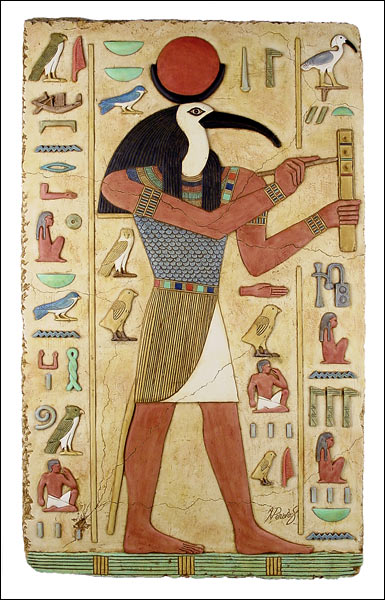

Background on Talismans

So, what exactly do I mean my talisman/charms? Well, whatever comes to your mind when you hear the words, that there is your talisman. There’s really no “correct” occult definition for it, and it varies among cultures. Typically, it is some sort of object worn around the neck. It may have religious, cultural, or even personal significance. Of course, talismans which combine all three have the strongest impact on the wearer.
Traditional pendants involve religious symbolism. Think metallic/wooden crosses worn by Christians, often made of silver. Another example would be the teeth of some dangerous animal, like a bear or tiger, common in tribal cultures. There’s those rare flat stones with holes in them, formed by river action, that were worn by pagan Europeans to protect them against evil spirits. In Hindu tradition, people sometimes wear small silver capsules, in which there would be a small rolled up piece of paper inscribed with an entire hymn. Other examples include precious stones, motifs on clay/copper tablets, or objects that are important to people, perhaps given to them by someone important.

photo-1544015066-b2c47a7d3305.jpg

Some modern examples are metallic disks or sculptures, with words or images inscribed on them, representing national identity, religious creed, political ideology, or occult symbolism. Obviously, in modern times we can produce much more intricate and beautiful objects, although the belief in and use of talismans in much more rare.

When people wear such objects, it is usually as jewelry. The only case where it has any spiritual significance is in case of religious symbols, like a Cross, a Hammer of Thor, a Swastika etc.

There’s this amusing example of the modern Hindu talisman. Instead of being a hymn on a small piece of paper, written using a secret technique, they use lasers to print it onto a tiny bit of glass. This is fitted into a cheap metallic case, with a small magnifying lens as well. Looking through your tiny pendant, you can see the hymn. These are then sold in bulk through telemarketing, promising all sorts of miraculous effects, similar to televangelists in America. How religion has devolved. Such items don’t have nearly as much power as a traditional talisman. I always say spiritual/religious gimmicks or scams as the worst kind of thing, because they prey on the desperate and the alienated, and god knows that’s what most young people are today, without offering any real value for the large sums of money they make.

We can say that some general characteristics of Talismans is that it is an object that is precious, unusual, or of personal importance. Like all magick objects, the amount of time and energy invested into one will increase it’s connection to you, and the stronger it shall be. Personally, I feel that a talisman of personal significance, such as an something given to you by a friend or loved one, or an heirloom (or an object a Deity or Spirit personally blessed for you) etc. has more power, but this is not required, as you’ll see.


How I Use Talismans

A talisman has a strong psychological significance. One of the best uses of one is for protection. And I have found from personal experience that they work extremely well.

So, let’s take one of my most important talismans. Those of you who’ve read this blog in the past know that I live close to New Delhi, and you also know that I really, really dislike the place. It is a city teeming with negative energy and parasitic entities, and has a long history of tyranny and bloodshed. It is also the most polluted capital city in the world (and that’s not an exaggeration). Now, this has various reasons, but I guess being the bastion of socialist thought, corrupt bureaucracy, crime and elitism for 70 years does a number on a place.

Capital cities have this aura about them, that is turbulent and dangerous. I have also felt it (though much less) in Amsterdam and London, and to a minor extent in Tokyo. There is great beauty, but also great evil.

So, simply put, living in New Delhi harms one physically, mentally and spiritually. Even though it is the Indian capital, Delhi is one of the rare places that has no patron Deity, and most of the intellectual manpower migrated to surrounding regions. Look I wont bore you with details, but think New York with Beijing’s air, Soviet governance and English classism. That’s basically it. The Muslims in India call it “City of Jinn”, and for good reason. Jinn are evil spirits in Islam.

Bear in mind, i’m not saying all people living in the city are bad. It’s just not a very nice place to live in. There’s good and bad stuff.

air-pollution-afp_650x400_71513090945.jpgLike there’s cool stuff, but you can’t see it because of smog.
Unfortunately, I often have to travel there. A few years ago, when I wasn’t aware of this problem, I’d managed to track in some sort of vampyric spirit that had begun to attack me and my family, causing ill health and turbulent times, and I had to perform an exorcism and cleansing to drive it out. It was somewhat dramatic, and you can read about it here.

I had to make sure that it didn’t happen again, and would make extensive use of protection magick. Eventually, I decided to create a talisman that would protect me passively, and it works wonder.

Not only does it keep me safe from negative spiritual influences, it keeps my mental state in check and also seems to physically repel the air pollution. Once upon a time, returning from Delhi would leave me tired and drained, in a very bad mood and with a sore throat, and out of action for like a day and a half. I’d usually have some sort of bad encounter, and banishing whatever minor entities had attached to me was almost a given (I usually call on the energy of mars to remove them from my aura, then cast them into the womb of the Earth Mother, to hopefully be transformed into something good).

Now, since I started using the talisman, that does not happen at ALL. Bear in mind, this is despite protective magick I do anyway, and daily rituals. If I, an occultist, am affected so badly, it’s really no wonder most ordinary people hate the place.

Another cool thing I’ve noticed that my talisman radiates power. At first I believed it to be largely a psychological phenomenon, with the talisman simply being a subconscious trigger that causes you to be extra vigilant against negative thoughts and emotions (and possibly causing your body to eject any particulate that enters). But, after repeated use, it becomes warm and heavy, and I can feel the heat even from a few inches away. After cleansing and reconsecration, it becomes cold against my chest, and almost appears to “shine”. It’s not just psychological, at least not anymore.

photo-1495333003700-eb75daae834b.jpg

I wear it around my neck, under my shirt (I have no interest in exposing it to unwanted eyes). I also have a second talisman I made recently, which I consecrated during an invocation of Dionysus (more on that in a future post). It’s a small pine-cone I found many years ago in the mountains, when I was a kid, and I’ve had it all these years. Perfect raw material.

Instead of trying to give a generic creation method, i’ll instead tell you how I created both of these, and my reasons for each step. That should give you a deeper understanding of the process.

As a side note, I should warn against over-protection. Bear in mind that I don’t wear this talisman all the time, or in day to day life. You don’t want to begin to rely too much on this type of magick, since it can keep you from facing challenges that will help you better yourself. They can also limit your social interactions. I only wear my talisman when I go to Delhi.

Think Frodo and the One Ring. Think of Gandalf and his magical powers. They certainly use their powers, but the real “magick” is in them. Frodo wasn’t able to enter Mt Doom because he used the power of the One Ring. He did so because his journey had transformed him, and given him courage, faith, strength and resilience, and helped him actually destroy the Ring (power). Gandalf is so powerful not because he solves all problems with a flick of his staff, but because of his knowledge, foresight and wise counsel. Spells and chants simply make them more formidable, but they’re extensions of magick, not magick itself.

Sauron is the one who is pathetically weak, not even having a body, and NEEDS the One Ring in order to command any real power. Without that, he simply disintegrated before Isildur’s blade. He would have been slain by Celebrimbor had he not tricked him into making the Ring in the first place. A true talisman would be Aragorn’s blade, or the Arkenstone, or that little vial of Light, or those guidance necklaces that the Elves made. Objects of great, positive power, but tools at the end of the day, to be wielded by those who are worthy.

(I’m sorry to all those who have no idea what i’m talking about)


Creation of a Talisman

Alright, so the first, and most important step is intent, as it is in all magick. My intent was protection. Protection from negative influences, be they spiritual, mental or physical.

Next comes choosing an object, and this is where you must get creative with symbolism. For example, for the talisman consecrated by Dionysus, I used the pine-cone. Pine-cones are a symbol of fertility, as well as the Wild. They are associated with Mercury and Dionysus. For my protection talisman, I chose a small pendant I had. I do suggest using something you already have had or have made, because it already has a connection to you. In this case, the pendant is made of obsidian, and shaped like an upside down 2D obelisk. Embedded vertically along the front face are 7 little spheres of different stones, symbolizing the chakras. This is attached to a silver cap that has a small ring, so you can thread it.

I know, sounds fancy. It wasn’t actually very expensive. I’d picked it up in some new age shop because I thought it looked cool when I was a teenager. I too, wore it for cosmetic purposes. Over time, I became less edgy and didn’t wear such things in public, but it stayed with me safe and sound.

Now we have both intent and object, so it was time to plan the ritual. You must decide what spiritual forces you must invoke. So, in this case for protection, I naturally chose Jupiter. However, you can get creative here too, and assign your own meaning to the talisman, based on physical attributes. For example, this pendant was a black inverted obelisk. Obsidian is used for protection, but a black inverted obelisk is strong Binah/Saturn imagery. The silver cap corresponds to the Moon. Both are associated with Water, which also has strong relation to an inverted obelisk and Binah.

I defined the talisman as having the following attributes: The black obelisk, corresponding to Saturn, would absorb an negativity born in me, because after all, it isn’t the external influence itself that is harmful, but our reaction to it. Touching my chest, it would take into itself any dark thoughts and emotions I experienced, since Saturn is associated with banishing and transforming, and meanwhile the silver cap would create a reflective shield around me, that would send all evil back to the place from where it was coming, like a mirror. It’s a easy, passive way to ensure that people/entities who seek to dump their trash on you have it flung back to them, but at the same time you don’t need to get involved in any trash flinging of your own. The Water symbolism was for purity and cleanliness (and was enhanced since I would anoint the thing with oil), and the 7 stones for the Chakras mean that this pendant protects you on each level, from the Crown to the Root.

As you can imagine, such careful and precise consecration works really well. I also prepared some protection oil, using the powers of Jupter, to add an extra layer of protection and keep the pendant itself clean (the oil becomes like a container for the negativity).

Now for the process. It begins with a cleansing, traditionally done with water and smoke (incense). Say any preliminary invocations if you want (LBRP, Kabbalistic Cross, Middle Pillar etc.). Ideally, take the time into account. For me it on the Day (Thursday) and Hour of Jupter, during the waxing moon. Prior to this, I’d left the Talisman is some salt for about a weak, so it would be a clean slate. I took a stick of frankincense and make it go round in a clockwise direction around the pendant. Then I cleaned it with a clean, damp cloth. Ideally you’d use holy water, but I just used regular water to great effect.

Then comes the consecration, and this is where you Invoke the forces with which the pendant is to be blessed. I believe I invoked Water first. Then Saturn and the Moon and visualised their energies going into the talisman, stating how the talisman will work.

To seal the talisman, I invoked Jupter and stated the larger purpose of the talisman (to protect), while anointing it with my protection oil. Now I gave thanks, banished and closed the ritual. The talisman was ready!

Now, you may be wondering, does a talisman blessed by Jupter but  partly consecrated with the power of Saturn not cause issues? And to you I say: probably.

But, so far nothing of the sort has happened. The talisman hasn’t spontaneously shattered or imploded, nor have I witnessed things going wrong around it. Who knows, maybe I just managed to do it right.

For the acorn, it was much easier. At the peak of the Rite of Dionysus, when I was closely communed with the deity, I asked him to bless the little acorn, and empower it. He then stated it’s purpose, and informed me how I was to use it.

All talismans, and indeed all magical objects are empowered over repeated use.

photo-1547807277-7fa9b944effe.jpgPrayer beads are a classic example of Talismans blessed through repeated ritual


Use and Maintenance

So, depending on the nature of the talisman, it may or may not require reconsecration. This varies wildly, and it’s entirely up to you (or the traditions which you follow) that will define how this is done.

For my talisman, I mentioned that as it absorbs more negativity, it grows warm and heavy. And it’s difficult to explain, but I get a sensation of “tiredness” from it, as if it is weary and exhausted. Technically, it should have been able to endure several uses, but Delhi really is so bad that a it it needs cleansing after being worn for only one day (two if I didn’t spend as much time in the city).

Remember how I said the oil is the carrier of evil forces? After I return from Delhi, I put it away to rest. This isn’t really needed, but I need to use the talisman only once a week or so, so I keep it covered, laying on a bed of cloth (these things should be treated with respect).

Before I must wear it again, I take the damp cloth and clean out the oil (that carries the absorbed energies), while visualising the talisman filled with brilliant white light and reciting “Be now clean and pure, and blessed by the Divine”. After that, I once again anoint it, now reciting it’s purpose to “protect me from all evil. Be my shield in the face of darkness”. I dunno, get poetic (you know, like the Christians.)

gdbnsft0r3i21.jpg

After this, it feels light and cool again, and the reconsecration is complete.

I think it would be wrong if I didn’t mention my doubts. I have had the thought that perhaps, the talisman becoming warm and heavy is actually a sign of it being empowered and solely growing in strength, and maybe when I clean it and re-anoint it, i’m actually resetting it. Perhaps I shouldn’t actually mess with it once it’s anointed, and maybe Saturn banishes the negative energy on it’s own. Maybe I should just put it on some Earth to ground it.

I don’t know if this is true, but my intuition tells me that cleaning it is the right choice, and so I do it. There’s always going to be room for doubts, but we must trust ourselves. The air of Delhi has particulate in it, stuff like arsenic and lead. I don’t want that shit on my talisman, and it clearly attracts it (I can see a fine layer of white dust on it after one use). So, trusting my instincts, I do what I feel is right. And the instincts are the voice of the Self.


Well, that was all. Spring is upon us, so expect far more posts on this blog. I’ve decided to update it more regularly now. We do live in the Age of Information. So I’m doing my part. 

If you liked this, be sure to follow the blog. You can also follow me on Instagram @WhiteRavenMagus.

Well good luck, take care, and until next time. This has been White Raven, signing off.